Why a resin mini still smells after wash and post-cure
You followed the post-processing routine: washed the print, dried it, ran it through the UV cure, and it still smells. That is common, and it does not have a single cause.
Here is the direct answer. Washing and post-curing do not remove resin or solvent trapped where cleaning and light cannot reach. When a processed print still smells, investigate four possibilities rather than assuming one cause:
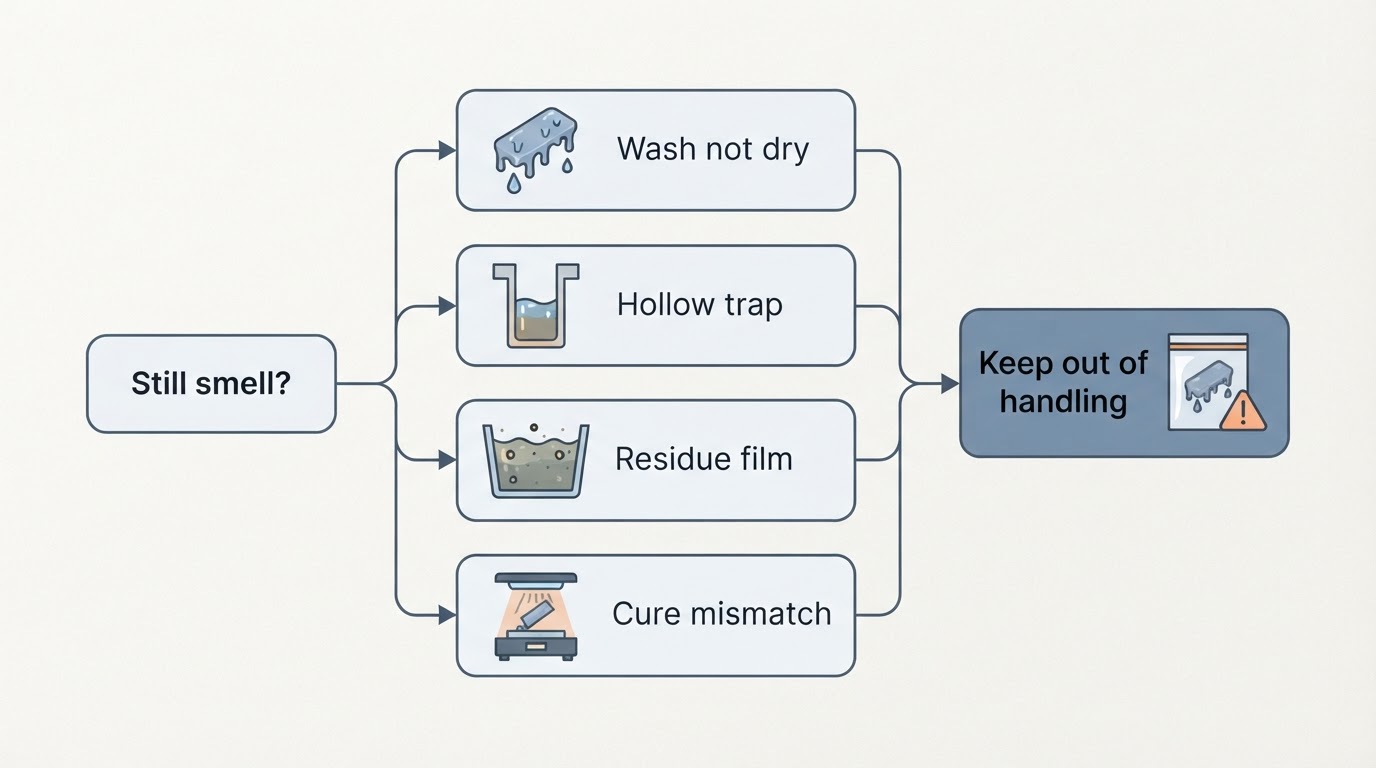
- Wash solvent (isopropyl alcohol or water) that has not fully evaporated.
- Uncured resin trapped inside a hollow model or in deep details.
- A wash that left a film of redissolved resin on the surface.
- A post-cure that did not match the requirements of that specific resin.
Odor is a useful clue, but it is not a measurement. As resin manufacturer AmeraLabs explains in its resin safety guide, odor is not a reliable indicator of cure, because many of the harmful monomers are largely odorless at typical exposure concentrations. A faint smell can hide reactive residue, and a stronger smell can come from solvent rather than resin.
This article covers a print that went through both the wash and the post-cure and still smells. For the broader timing question, use the site's resin miniature curing guide. A failed print stuck to the FEP is a different failure with a different fix.
Branch 1: the wash has not fully dried
A print washed in isopropyl alcohol can retain solvent in recesses or hollow sections after the visible surface looks dry. A solvent smell after curing is one clue, not proof of which material is present. The resin maker's wash and drying instructions take precedence.
AmeraLabs's post-processing checklist is explicit about the order: wash the print in IPA before post-curing, then allow it to dry completely before UV exposure. Water-washable resins follow the same principle. The liquid that carried away the resin still has to leave the part before the surface is sealed.
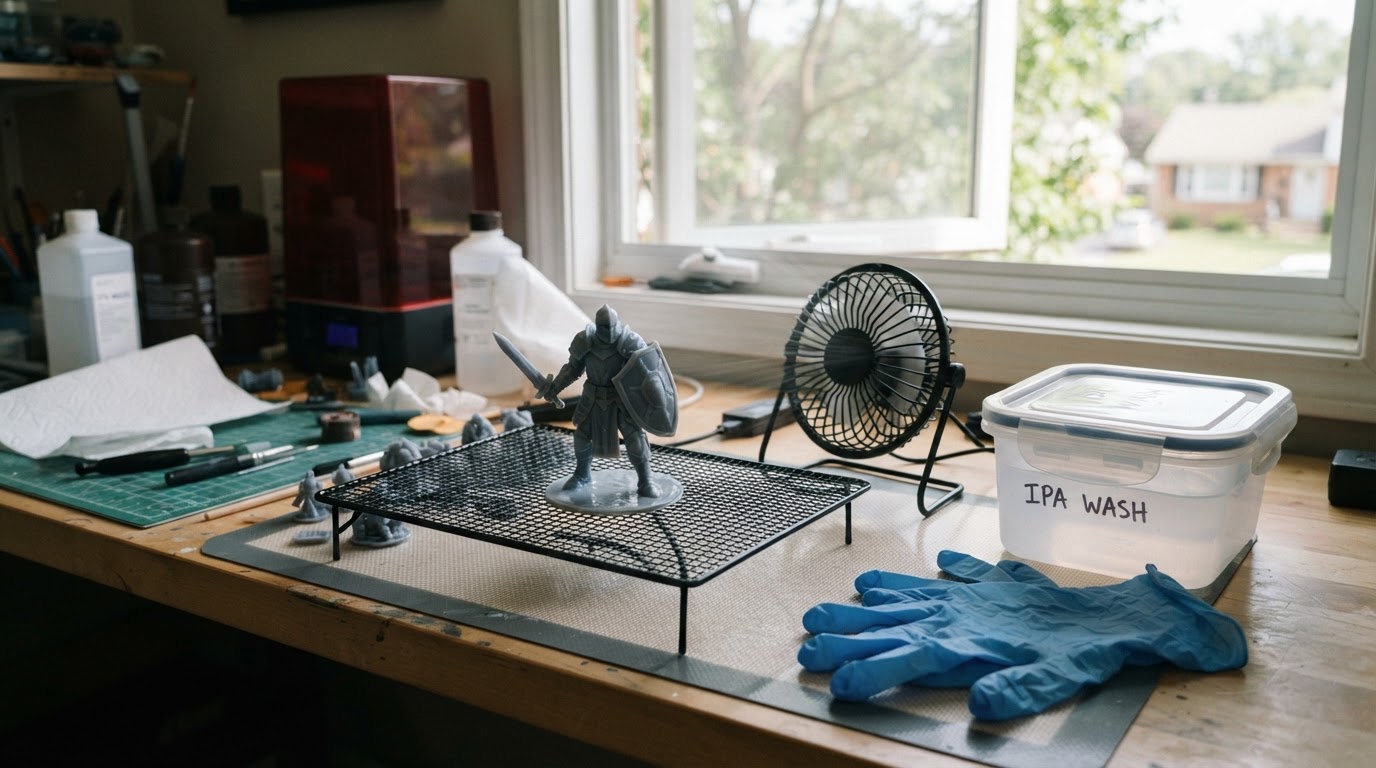
What to do on a future print: after washing, let it dry fully in a ventilated space before curing, as the resin maker directs. For an already cured part, do not infer from smell alone whether solvent remains; inspect recesses and follow the material maker's post-processing guidance.
Branch 2: uncured resin is trapped inside a hollow model
A hollow miniature can look finished on the outside while liquid resin sits inside it. Drainage paths get blocked by cured resin, supports or later handling, and a deep recess or support socket can hold a pocket of resin that the wash never reached. AmeraLabs notes that a print's surface may feel dry while liquid resin remains in details, hollows and between layers.
Clues worth checking:
- The smell is strongest near an opening, seam or drainage point rather than spread evenly across the model.
- A spot feels tacky, slick or slightly soft, or a bead of clear or amber liquid appears at a hole.
- The smell returns or intensifies when the part sits in a warm room instead of fading.
If any of that matches your print, treat the part as uncured rather than cured with an odor problem. Keep it out of normal handling, put gloves on before touching it, and work in a ventilated area. Follow the resin maker's instructions for that product before you display it, paint it or hand it to anyone else.
Branch 3: the wash left a residue film
Cleaning power drops as wash liquid becomes saturated with dissolved resin. At some point the bath stops lifting uncured material away and starts leaving a thin film of it back on the surface, especially in recesses and under supports. That film can then be post-cured into a partly reacted skin that keeps smelling.
Practical checks:
- The wash liquid is visibly cloudy, discolored or sluggish instead of clear.
- Recesses feel slightly tacky or glossy after curing even though flat areas feel fine.
- Re-washing with clean liquid changes the smell.
Use the wash method and liquid-replacement schedule your resin maker specifies, and follow local rules for contaminated wash liquid. Never pour resin-contaminated solvent or wash water down a drain. AmeraLabs classes uncured resin and contaminated IPA as hazardous waste, and Prusa's resin guidance says liquid resins should be treated as dangerous chemicals and disposed of under local rules.
Branch 4: the post-cure did not match the material
Post-curing is a UV dose question: intensity, wavelength and time all matter, and each resin formulation has its own recommended protocol. Two failures show up in hobby setups. The first is a part that never received enough dose; under-cured prints retain higher levels of unreacted monomers, which is exactly the material that smells and reacts. The second is an uncontrolled cure, such as relying on sunlight, where the dose shifts with season, time of day, cloud cover and glass and cannot be measured. AmeraLabs recommends a dedicated cure station matched to the resin's photoinitiators, used with the manufacturer's protocol.
What to do: use the cure settings the resin maker publishes for your specific product and cure station, then inspect the surface as an additional check. Neither a smooth surface nor a faint smell independently confirms full cure. Do not stretch or shorten the cure only because the part smells.
What the smell does - and does not - prove
This is where most resin-odor advice goes wrong in both directions.
A lingering smell does not by itself prove the print is unsafe to touch, and a lack of odor does not prove safety. AmeraLabs emphasizes that no single test confirms full cure: follow the resin maker's specific wash, dry and post-cure protocol, then inspect for tacky or wet patches. Surface appearance varies by resin, so do not assume every glossy part is uncured or every matte part is safe. A suspect print stays out of normal handling until its product-specific instructions have been satisfied.
How long does resin smell last?
Once the source is gone, smell may fade at its own pace. AmeraLabs reports that workshop VOC levels can remain elevated after printing and that some cured parts may continue to emit odor for longer; those observations are not a countdown for deciding when a particular miniature is safe.
That timeline is more useful when you read it together with the branches above:
- A faint smell that fades in a ventilated room may be residual odor, but verify the maker's process and the surface rather than relying on time alone.
- A smell that stays strong, grows stronger, or stays concentrated around a hollow or seam points to trapped uncured material or wash liquid, which time alone will not fix.
- An alcohol-like smell is a reason to check for residual wash liquid, not proof of the exact source.
Elapsed time is not proof either way. Combine it with the surface checks before you decide what to do with the print.
Handling rules while you troubleshoot
Whatever branch you are working through, the same rules apply while a print may still hold uncured material:
- Wear nitrile gloves whenever the print is uncured or tacky. Treat every fresh print as contaminated until it is fully processed.
- Work in a ventilated space. Prusa's guidance notes that resin produces fumes and the room should stay ventilated; AmeraLabs recommends exhaust to outdoor air rather than recirculating filters.
- If resin contacts your skin, wash with soap and water. Both manufacturers direct you to soap and water, and AmeraLabs specifically warns against using IPA on skin because solvents can increase penetration.
- Keep prints and resin out of the reach of children and pets.
- Never pour liquid resin or contaminated wash liquid down the drain; collect waste and dispose of it under local hazardous-waste rules.
- Read the safety data sheet (SDS) for your exact resin. It is the authority for that product's hazards and handling, and formulations differ.
Quick decision table
What you notice | Most likely branch | Safe next step |
|---|---|---|
Smells of alcohol or solvent, surface dry, fades in open air | Wash not fully dry | Finish drying in a ventilated space before further cure or handling |
Smell strongest at a hole or seam, tacky or weeping spot | Resin trapped in a hollow | Keep out of handling; follow the resin maker's instructions to clean and re-cure |
Recesses slightly tacky or glossy, wash liquid cloudy | Residue film from a saturated wash | Re-wash with clean liquid using the maker's method, dry fully, then re-cure to protocol |
Hard, dry and non-tacky, faint smell that fades | Possible residual odor | Compare against the resin's post-cure protocol; ventilate and re-check rather than re-curing blind |
Sticky patches after a full, correct cure | Incomplete cleaning or wrong cure protocol | Treat as uncured and repeat the maker's wash-and-cure process, or set the print aside |
No smell at all | No information | Do not skip gloves, ventilation or the SDS; odor is not a safety test |
The one rule that beats every diagnosis
If a print stays tacky, keeps weeping, or still smells strongly after you have repeated the resin maker's own wash-and-cure process, stop troubleshooting and treat it as suspect. Keep it out of normal handling, do not paint it, and follow the resin maker's instructions for your product. Odor is a reason to check a print carefully, never a reason to relax.