Airbrush Gun Types for
Miniature Painting
Picking an airbrush gun for miniature painting is easy once you know there are really only three decisions: how paint gets delivered, how you control the spray, and how fine the spray can go.
Three Choices That Define Every Airbrush Gun
Every airbrush gun — from a basic beginner model to a professional one — is defined by the same three characteristics. Understanding them before you shop means you stop guessing at specs and start matching a gun to how you actually paint.
01Feed System
How paint moves from the cup or bottle into the air stream (gravity, siphon, or side).
02Action Type
How the trigger controls airflow and paint volume (single-action or dual-action).
03Nozzle Diameter
How fine or broad the spray cone is (measured in millimeters).
Feed System: Gravity, Siphon, and Side Explained
The feed system determines where the paint cup sits and how paint travels to the nozzle. For miniature painters, this choice affects how much paint you load and how easily you clean between colors.
Gravity Feed
Paint falls downward into the air stream. Gravity feed is a common choice for miniature painters because it handles small volumes and makes colour changes quick. Feed type only decides how paint reaches the nozzle; it does not compress air or set the pressure you can use.
Siphon Feed
Draws paint up from a bottle below. Best for large volumes, priming terrain, or painting vehicles where you don't want to refill constantly.
Side Feed
Cup attached to the side for a clearer line of sight. Less common for general miniature painting, favored by technical illustrators.
| Feed System | Cup Position | Works Best For | Not Ideal For |
|---|---|---|---|
| Gravity feed | Top | Detail layers, color switching, small models | High-volume base coating sessions |
| Siphon feed | Below (bottle) | Terrain, vehicles, large batch priming | Quick color changes, fine detail |
| Side feed | Side | Close-up overhead work | General miniature painting |
Single-Action vs Dual-Action: Which Controls the Paint?
Single-Action Airbrush
Pressing the trigger releases air and paint together; the fluid control sets how much paint is available, and you adjust it before a pass. It is consistent, but changing paint volume mid-stroke means stopping. With a fine nozzle and careful settings it can still spray small areas; the limitation is on-the-fly adjustment, not the trigger type alone. Iwata's Revolution HP-SAR is one documented siphon-feed single-action example.
Dual-Action Airbrush
A common choice for miniature painting. Pressing down releases air; pulling back adds paint. That lets you vary spray width and density mid-stroke, which many painters find useful for glazes, blending and highlights. It is a control advantage, not a requirement for every job.
Nozzle Diameter: The Precision Scale
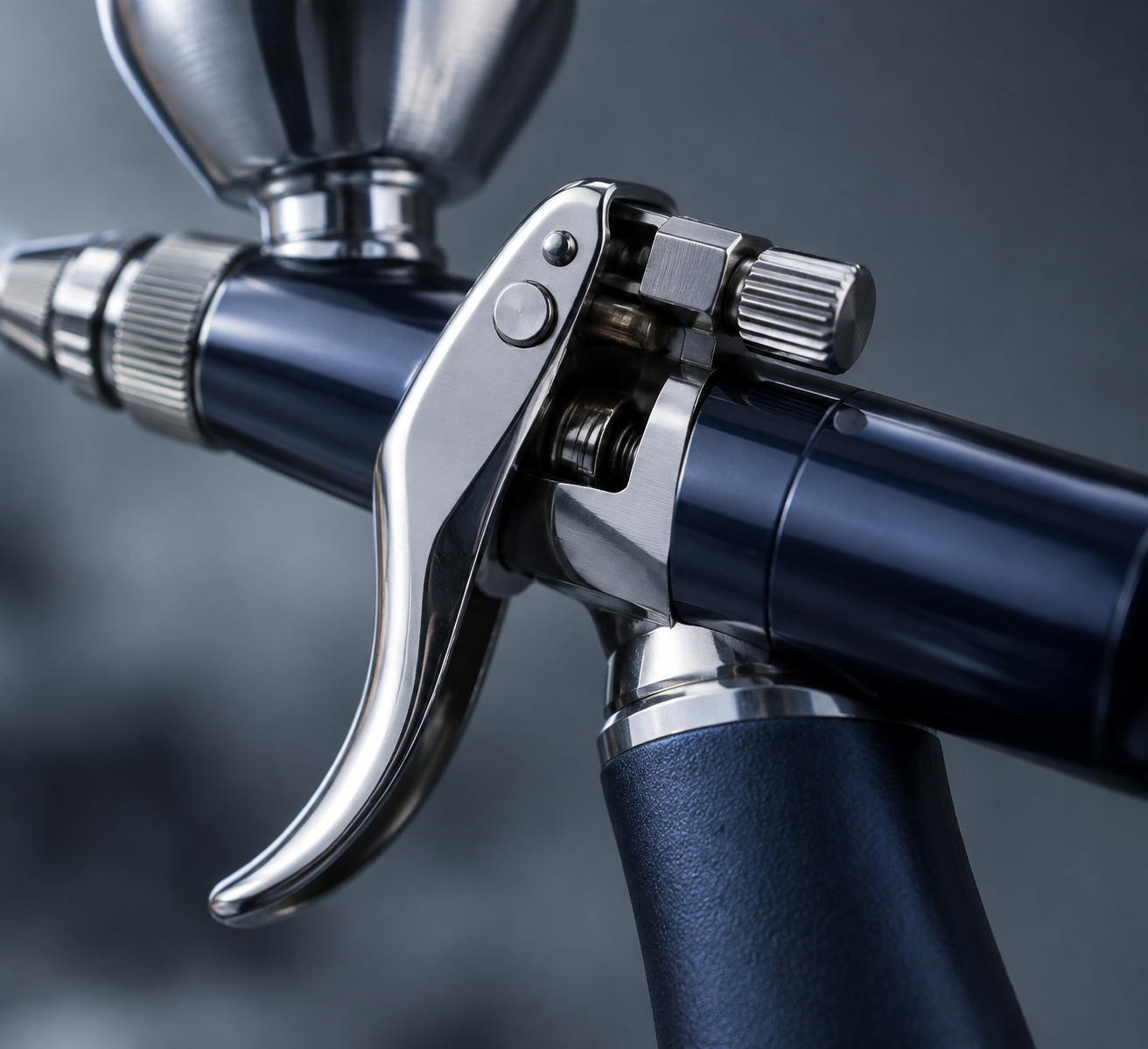
Nozzle diameter influences the spray pattern and how much thinning a given paint may need, but it does not by itself set the finest line you can spray. Needle and nozzle condition, paint viscosity, pressure, distance and trigger control all contribute. Smaller nozzles are generally less forgiving of thick paint; larger ones cover area faster.
Nozzle and pressure are a system. Start with the range the airbrush maker lists and test your paint on scrap. Working pressure varies with the airbrush and material, as Iwata's FAQ notes; a smaller nozzle does not automatically produce a finer line if the paint or trigger control is wrong.
The Precision Specialist
A fine nozzle can produce thin lines, but it is less forgiving of thick or partly dried paint. Choose it for detail work if you are prepared to thin and test carefully.
The Daily Driver
A common middle choice that handles many miniature tasks, but not the only sensible starting size. 0.2 mm, 0.35 mm and 0.4 mm all have uses; match the nozzle to your paint and the size of the surfaces you paint.
The Smooth Finisher
A mid-size nozzle that can suit broader work and somewhat thicker paint than a 0.2 mm, depending on the brush and paint.
The Batch Painter
A larger nozzle can cover broad areas faster, but coverage also depends on pressure, paint and distance.
Which Airbrush Gun Type Fits You?
Gravity feed · Dual-action · 0.3 mm nozzle
A common starting combination, not a requirement. It covers many techniques, but a single-action or another feed can also work for basecoating.
Gravity or Siphon feed · Dual-action · 0.35–0.4 mm
Covers large surfaces faster with less refilling.
Gravity feed · Dual-action · 0.2–0.3 mm nozzle
More control for fine work within the limits of the nozzle, paint and your trigger technique.
Common Buying Mistakes
Choosing single-action without checking the trade-off
It is simpler and can be a good fit for basecoats, but changing paint volume mid-stroke means stopping to adjust. Decide by the work you plan, not by price alone.
Assuming a very fine nozzle is the best start
A 0.2 mm nozzle is less forgiving of thick paint and can clog if the paint/nozzle/pressure combination is wrong. A mid-size nozzle is often easier to learn on, but the right choice depends on your paint and detail goals.
Skipping the compressor budget
Inconsistent air pressure causes more problems than the gun itself. Check working pressure, airflow and duty cycle, and get a regulator.
The Airbrush Gun Is the Core — Here Is What It Needs
- Air compressor: A regulated air supply with a moisture trap. Check the compressor's working pressure, airflow and duty cycle against your airbrush and paint.Learn more
- Airbrush paint: Paints labelled for airbrush use are one option; many hobby paints work when thinned. Follow the paint label, and test.View guide
- Airbrush cleaner: Removes paint faster and protects the needle.See recommendations
Thinning Is a Variable, Not a Magic Ratio
The paint-to-thinner ratio is one of the main variables in a clean spray. Use the calculator as a starting point, then test the mix on scrap and record the ratio you used.
Try the Thinning CalculatorReady to Master the Trigger?
Learn the foundational techniques: pressure, distance, trigger control, and consistency. Separating a rough spray from a smooth blend starts here.
How to Airbrush Miniatures GuideAirbrush Gun Questions
What is the difference between an airbrush gun and a regular airbrush?
They refer to the same family of tools. Some use 'gun' for siphon-feed pistol-grip models, but the terms are interchangeable across the community.
Is gravity feed really better for miniature painting?
Not universally. Gravity feed is often easier for small volumes and quick colour changes, while siphon or side feed can suit batch work or a different line of sight. Feed type alone does not determine spray quality.
What nozzle size is best for a beginner?
A mid-size nozzle such as 0.3 mm is a common starting point, but it is not universal. A 0.2 mm can work with careful thinning, and 0.35–0.4 mm suits broader coverage. Match the nozzle to the paint and surfaces you plan to spray.
Do I need a dual-action airbrush?
Many painters prefer it for mid-stroke control, but it is not required. A single-action brush can handle basecoats and, with a fine nozzle and careful setup, small areas; dual-action mainly buys on-the-fly control.