Choose by Shape and Post-Cure Finish
Milliput and Green Stuff are both two-part epoxy putties, not air-dry clay. Green Stuff is Kneadatite, not the similarly named Liquid Green Stuff filler. There is no universal winner: judge each job by finish and flexibility.
Milliput suits a hard seam or rigid armor surface that will be filed, sanded or drilled. Green Stuff suits fine, flexible detail and sculpted cloth. For a thin load-bearing miniature joint, don't assume filler putty alone provides structural retention: choose an adhesive or pinning approach suited to the material and joint.
Timings come from each maker's label and are not interchangeable. Milliput's instructions give a hard set in three to four hours at 20–25°C, then a further full-cure interval of roughly equal length. The Army Painter TL5037P listing for Green Stuff sets a flexible working time of 20–30 minutes, permits sanding and shaving after about eight hours, and allows up to 24 hours for full cure. Those figures describe that listing, not every Green Stuff or Kneadatite pack, so read your own label. The Green Stuff working time guide covers the sculpting window.
Match the Putty to the Job
Task | Consider | Why it fits |
|---|---|---|
Seam or rigid armor surface you plan to sand | Milliput | Fully cured Milliput can be sanded, drilled and machined |
Fine flexible detail or sculpted cloth | Green Stuff | Keeps some elasticity and suits thin, flexible shapes |
Large bulk that needs support | Either, in stages | Build over a stable form or support rather than one thick lump |
Thin load-bearing joint | Adhesive or pin first | Choose hardware that suits the material and the joint; putty only shapes and hides |
The table is a first filter, not a ranking. Large bulk work is a staging job: build over a stable form or support in layers, letting each stage harden. Epoxy putties can bond, but a thin load-bearing joint still needs the adhesive the joint calls for; a pin reinforces that adhesive rather than replacing it.
Milliput Standard and Superfine White: Know the Grade
Milliput Standard is the general-purpose grade. Superfine White is the version Milliput formulates for a fine finish on porcelain and ceramic restoration, and it also lists modeling and sculpting among its applications. The Superfine White page sets out its mixing requirement, and the Milliput how-to page covers the rest of the range.
A finer grade narrows the finishing gap but does not replace practice: don't expect Superfine White to produce tiny detail regardless of skill. Once fully cured, it can be machined, drilled and sanded.
Green Stuff: Flexible Detail and a Different Finish
Green Stuff, sold as Kneadatite, is the flexible-detail option. Its cured state keeps some elasticity, which suits sculpted cloth and piecemeal detail where a rigid putty would fight the shape.
The Army Painter Green Stuff page sets the current product scope: an epoxy putty used with pinning and super glue, which the listing says can be sanded and shaved for a smooth, clean final result. Finishing cured Green Stuff is therefore supported, though it may handle and finish differently from Milliput. Where the job allows, shape and smooth it before it sets, and let the label decide readiness for the next step. Use it to blend and hide a joint alongside the adhesive, not as the structural element of a thin joint.
Mix Each Product by Its Own Label
Milliput's main how-to calls for equal parts, kneaded and rolled at least five minutes until uniform, then worked another minute; follow that exact label with thorough mixing rather than a shortcut. Superfine White's two components look similar, so follow its label and rely on thorough mixing rather than color change alone.
Green Stuff also mixes as equal parts of yellow and blue until the color is even. Do not blend the two putties into a mixed recipe; keep to each label's ratio and method. Follow the mixing and curing instructions for the exact product; this guide does not provide a heating, microwave, solvent-thinning or hybrid-putty recipe.
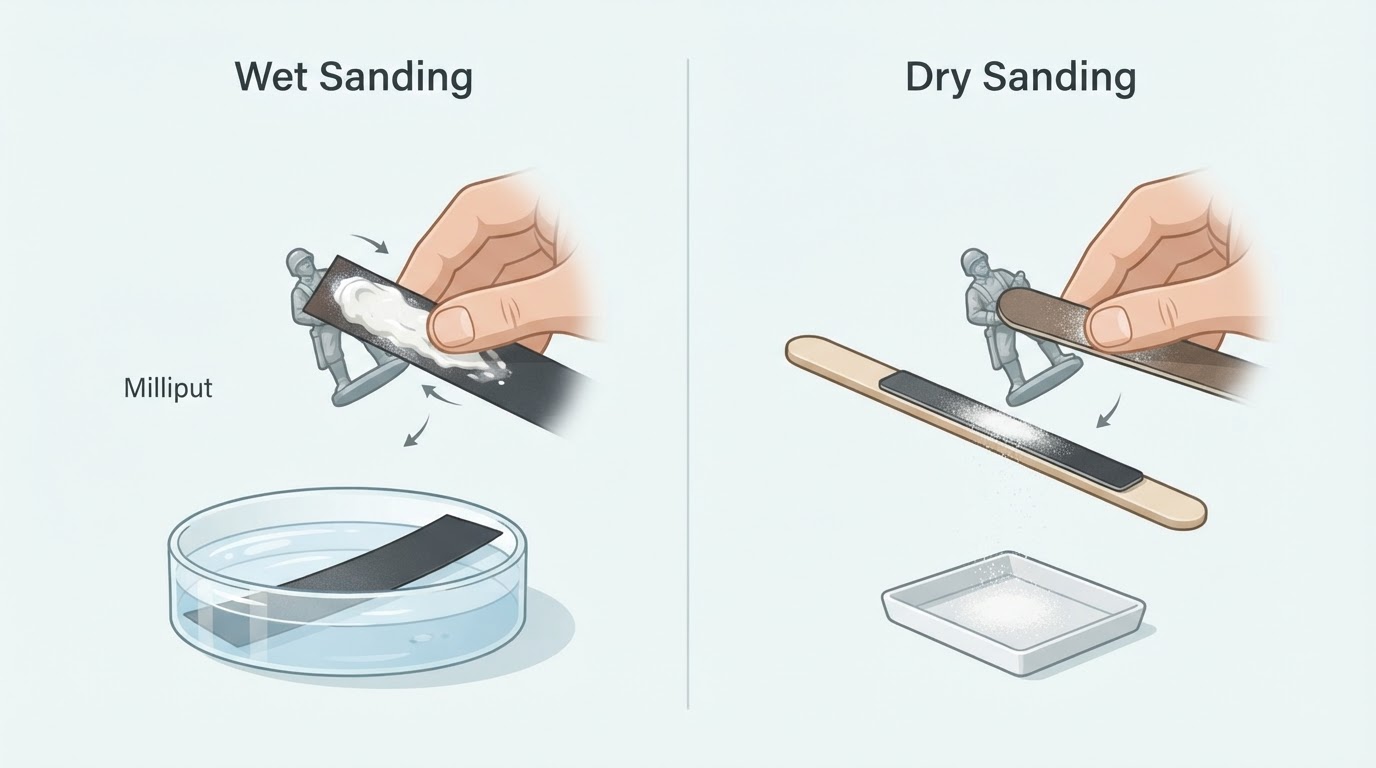
Water on tools is allowed for Milliput smoothing, but a watery slurry is a smoothing aid, not a guaranteed structural filler. Follow the label for gloves and dust control, keep putty away from children, and do not put tools in your mouth.
Run a Small Scrap Preflight
Before you commit a mix to the model, apply a small mixed sample to a spare offcut of the same material the model is made from. Let it cure for the time the exact label states, then inspect how it works and finishes. This is a practice check, not a published test: a sample that behaves as expected is a useful sign, not evidence that full cure or joint strength is proven.
The Bottom Line
For a seam or rigid surface that will be sanded, start with Milliput. For fine, flexible detail, start with Green Stuff. For a thin load-bearing joint, don't assume filler putty alone provides structural retention: choose an adhesive or pinning approach suited to the material and joint, then use putty to shape and hide the join.
For a mix that stays soft, see the Milliput not hardening guide. For timing, the Green Stuff working time guide covers the sculpting window, and the plastic glue vs super glue comparison covers joint choice.