The short answer
When a patch of Milliput has not hardened, check the mix first: two-part epoxy putty only sets as well as its components are blended, so measure equal portions and knead fully. Then compare the elapsed time and temperature with the maker's window, and review how the putty was stored. For a sample to watch, mix a fresh one, not the patch already on the model.
Check the mix on a fresh, unapplied batch
The manufacturer's how-to page describes the method: equal quantities from each stick, kneaded and rolled together until the colours merge with no streaks — at least five minutes, then another minute.
Milliput Superfine White is easy to under-mix because both sticks look similar before blending, so the Superfine White page stresses equal portions and thorough mixing for that grade. Measure the portions rather than judging the ratio by colour; the colour check is for blending, not for confirming amounts.
A quick check and next-action table
The rows below apply to a fresh, unapplied batch; stop at the first match. If a batch is already on the miniature, do not knead it again or add hardener to it — start a fresh batch instead.
What you are checking | What a problem looks like | Next action |
|---|---|---|
Portion balance | Portions cut by eye, or one stick ran out first | Measure equal portions; mix a fresh batch |
Kneading | Visible streaks remain in the mixed putty | Knead a fresh batch until uniform before applying it |
Elapsed time | Only a few hours old and slightly firm | Wait out the maker's 3–4 hour set window at 20–25 °C |
Temperature | Room colder than 20 °C, or a patch that stays soft | More room-temperature time; the maker says warmth can reduce setting time, but follow a method supported by the putty and by the model's material, glue and paint instructions |
Storage and age | Stored warm or damp, or history unknown | Run a witness sample; ask if unclear |
Rule out time and temperature
There is no single Milliput dry time. At 20-25 °C the maker describes the mixed putty becoming rock hard in roughly three to four hours, then continuing to cure for a further interval of about the same length at that temperature. Hard set is not full cure: firm at three hours does not mean finished, and there is no universal 24-hour rule to use instead.
Milliput's how-to says to mix equal quantities of the two parts, that the putty hardens in three to four hours at 20–25 °C and continues to cure afterward, and that application of heat can reduce setting time. That is a statement about the putty, not a heating recipe for a finished miniature: the model's material, glued joints and paint may tolerate less heat than the putty, and the maker gives no oven, microwave or hairdryer protocol. If a patch on a delicate model stays soft for no clear reason, give it more room-temperature time and mix a separate witness sample of the same batch; those are conservative checks, not proof that warmth cannot help the putty itself.
Age, shelf life and storage
Milliput shelf life is tied to storage: the maker gives an approximate two-year shelf life when the putty is kept cool, dry and sealed, and notes that heat and humidity shorten it. Colour alone cannot tell you whether a stick has passed its best. If the mix looked right and the patch still refused to set, raise storage and age with the manufacturer.
Run a fresh witness sample and keep a blank record
This is a proposed check, not a test reported here. Mix a fresh, independent scrap from the same sticks the same way, leave it in the same room as the model, and record what you observe:
Product or grade | Mix time | Room temperature | Observed after 4 hours | Later observation |
|---|---|---|---|---|
|
|
|
|
|
Leave the record blank until you run it. If the scrap hardens while the patch stays soft, investigate differences in kneading, application and surface rather than treating contamination as proven.
What not to do with a soft patch
Do not apply an improvised heating protocol — an oven, microwave, hairdryer or hot-water bath — to a patch on a finished miniature unless the putty maker and the model's material, glue and paint instructions all support that method for that assembly. Warmth may shorten the putty's set, but the model around it can be the more heat-sensitive part.
- Do not knead a patch already on the model, or mix extra hardener into it.
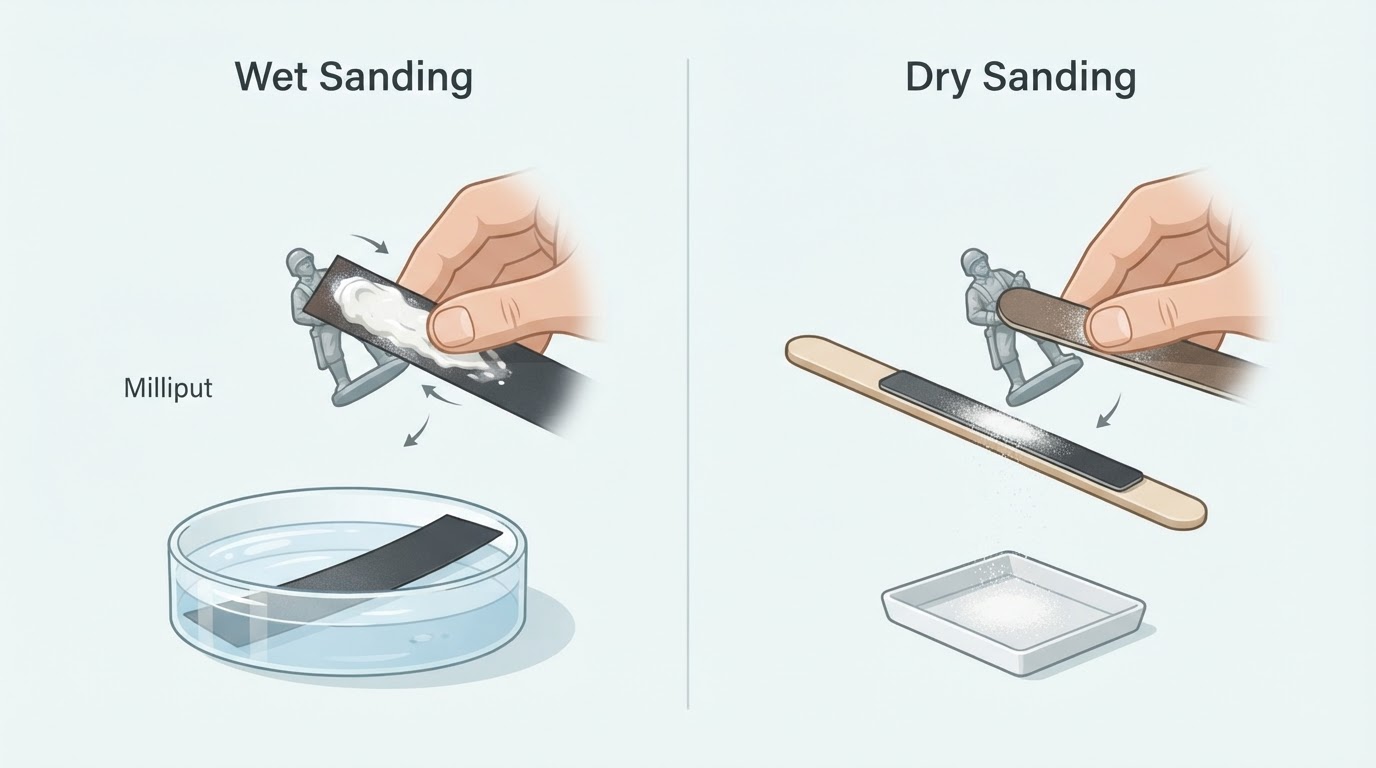
- Do not paint or sand over putty that is still soft.
- Do not reach for solvents to strip a finished plastic or resin model; ask the manufacturer about removal and compatibility instead.
Use water only as the maker describes, to stop fingers and tools sticking while you shape. A watery or slurry-modified blend is not a validated structural mix. Follow the package's handling precautions and wear suitable disposable gloves. Keep the product away from children; the maker's safety notes, not any food-safe or skin-safe claim, are authoritative.
Hold painting and sanding until it is cured
Wait until the patch is properly cured before you sand or paint it. If you are planning a build, whether to paint Warhammer before or after assembly is easier to decide once the filler has hardened. If paint is instead rubbing off a finished model, that is a different problem with different fixes — do not sand a soft patch hoping it is a paint problem. When removal or material compatibility is uncertain, ask the manufacturer before trying anything aggressive.