What a wet palette does to Contrast paint
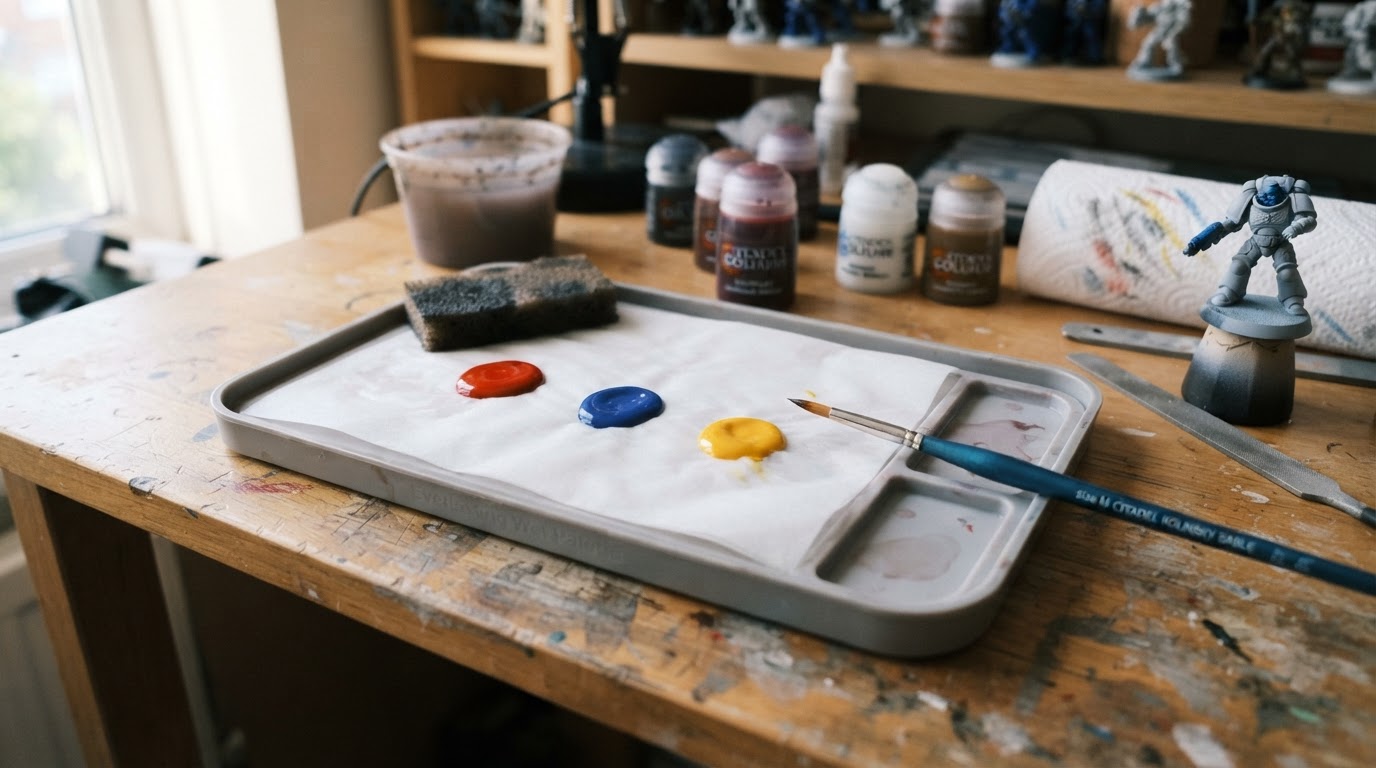
A wet palette is a shallow tray with a damp sponge under a permeable sheet. Water can move through the sheet into the paint. That helps many regular acrylic paints stay workable, but it can also change a pre-formulated Contrast paint's consistency while you work.
Contrast is designed to do two things at once: tint the raised surfaces and gather in the recesses to create shadow. Most of that effect depends on consistency. When a wet palette feeds water into the paint, three things can change.
- The color may become paler as the pool is diluted.
- Flow and pooling may change, making one application behave differently from the next.
- The intended recess shading may become less predictable.
For intentional thinning of Citadel Contrast, Warhammer's own hobby guide points to Contrast Medium instead of relying on water. This is a Citadel-specific recommendation. The Army Painter's Speedpaint how-to separately recommends a hard palette for that line because wet-palette moisture can alter the product and stain the foam; Speedpaint is not the same product as Citadel Contrast.
That does not prove a tiny amount of Citadel Contrast becomes unusable immediately on a wet sheet. It does mean a dry well is the lower-uncertainty default, and a wet palette should be treated as a small, short test rather than an overnight storage system.
Short session versus overnight storage
If you only have a wet palette, put out a tiny amount on a sheet without standing water and compare a test stroke with a fresh drop from the pot. How quickly the pool changes depends on the paper, sponge and room conditions; there is no verified universal ten- or twenty-minute window. Use a dry well when repeatable shading matters.
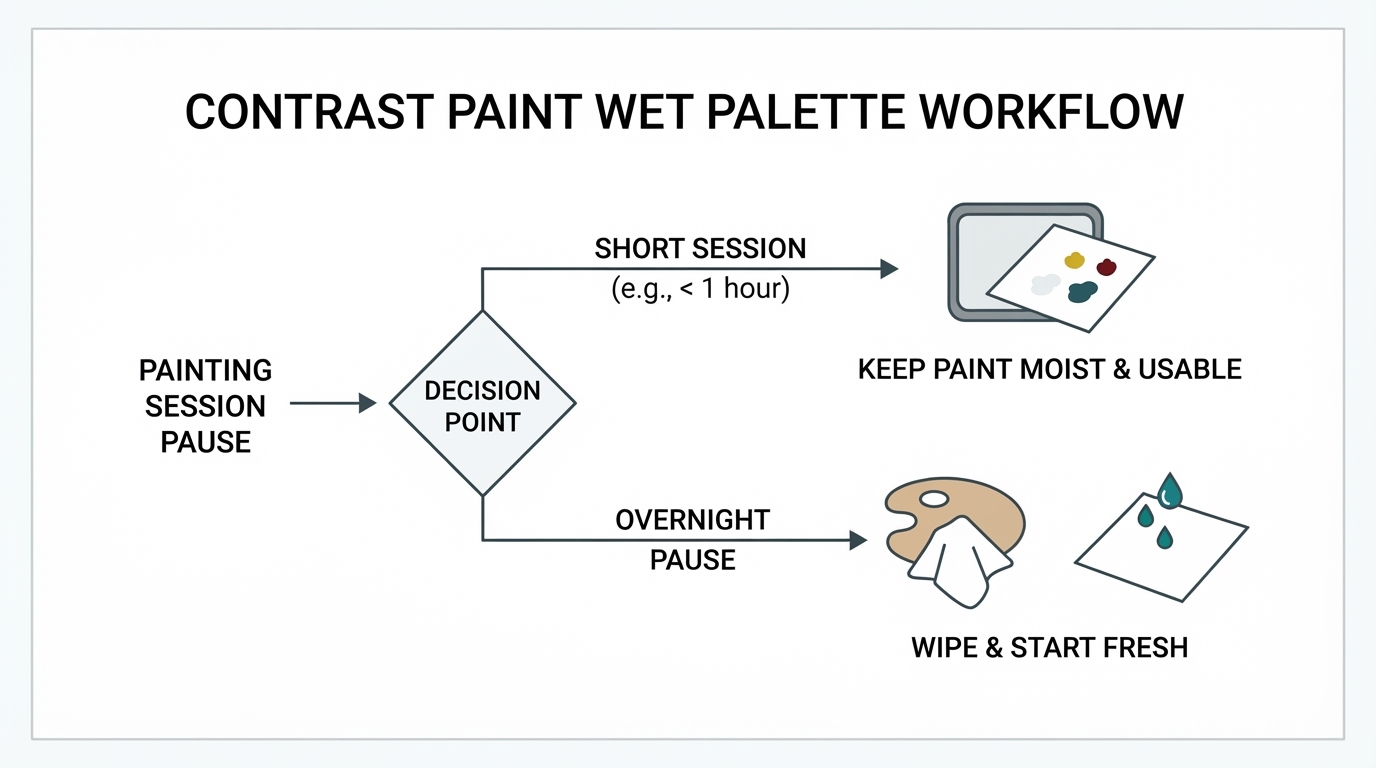
An overnight break is a different situation. The water keeps wicking into the paint for hours. By morning, a working pool can be thinner than you left it, separated, or ringed with watery pigment. How quickly that happens depends on your paper, sponge, room temperature and humidity, so treat any blanket claim that Contrast always survives a night on a wet palette with caution. For an overnight pause, do not leave the day's working pool in place: wipe it away, cover the palette so the sheet does not dry out, and put out fresh paint next time you sit down.
Keep the palette from becoming a mixing pot: do not tip wet-palette leftovers back into the pot, and never thin a whole pot on the assumption you can top it up later. The instructions printed for that paint are the authority, not a general rule.
A quick decision matrix
Situation | Wet palette? | Why | Better move |
|---|---|---|---|
One model, one short sitting | Possible as a small test | Moisture may change the paint | Compare with a fresh drop; prefer a dry well |
Batch painting one colour across a squad | Prefer a dry well | Consistency should stay repeatable across models | Put out small fresh amounts |
Overnight pause mid-project | No, not the working pool | Hours of wicking can separate or over-thin the paint | Wipe the pool, cover the palette, start fresh |
Mixing a thin glaze | Prefer a dry well | You want a measured, repeatable mix | Extend Citadel Contrast with Contrast Medium |
Matching an exact shade across several models | No | Moisture changes the mix as you work | Mix on a dry well and note your ratio |
Steps for using Contrast paint on a wet palette
- Prepare the palette. Dampen the sponge, lay the sheet flat and blot away standing water. A sheet that glistens is fine; a sheet with puddles will feed too much water into the paint.
- Place small pools. Keep each Contrast colour in its own spot with space between them; using less paint than feels natural makes over-thinning less likely.
- Thin only if you must. If a colour feels heavy or is gathering in detail, add a touch of Contrast Medium to the pool and mix gently.
- Paint one area at a time. Cover a single section in one smooth pass. Going back over damp Contrast pulls pigment out of the recesses and leaves streaks.
- Watch for wicking. If the pool starts creeping outward or the edges look watery, move that colour to a dry well or load a fresh dot.
- Finish clean. Between sessions, replace the sheet and wipe the palette so old pigment does not contaminate the next mix.
Compare the test patch with paint from a fresh drop. If its flow or shade is visibly different, discard the wet-palette pool and use a dry well; the appearance alone does not diagnose exactly how much water entered the paint.
Limitations worth knowing
A wet palette changes working time; it does not guarantee shelf life. There is no universal number for how long a diluted pool stays usable, because paper, sponge, water, room conditions and the paint all vary. Questions about contamination follow the same logic: keep the palette clean, use fresh water, and follow the manufacturer's guidance rather than trusting a general rule. Contrast also still skins over and dries, so the palette buys you time, not immunity. No palette fixes a heavy coat or a dark undercoat; those are technique problems, not moisture problems.
FAQ
Can I use Citadel Contrast paint on a wet palette at all?
You can test a small amount briefly, but a dry well is more predictable for Citadel Contrast. Do not assume the wet sheet leaves the paint unchanged.
Will a wet palette ruin Contrast paint overnight?
It can leave the paint thinner, separated, or watery, but the outcome depends on your setup. For an overnight break, do not gamble on the day's pool: wipe it away, seal the palette, and mix fresh paint next time.
Should I use water or Contrast Medium to thin paint on the palette?
For controlled thinning of Citadel Contrast, use the maker's Contrast Medium as described in Warhammer's hobby guidance. Water arriving through a wet sheet is harder to measure. For a different comparison of paint behavior, see our Contrast paint versus wash guide.