The short answer
Use Contrast paint when you want colour and recess shading from a single application over a light undercoat, and the surface has texture for the paint to settle into. Use a wash — Citadel calls it a Shade — when you already have the base colour you want and mainly need recess definition. A wash can also tint raised areas, especially if applied heavily.
Most painters end up owning both. Contrast is the faster route to a table-ready army; a Shade is the more controlled way to finish a basecoat you have already blocked in. The rest of this guide compares the two by coverage, recess pooling and finish, then gives you a decision table to use at the desk.
What each product is designed to do
Games Workshop describes Contrast as a base-coating paint that also shades. Its Battle Ready guidance puts Contrast in a parallel method to the classic workflow, telling painters to undercoat with Wraithbone, Grey Seer or White Scar and add one coat of Contrast per colour. The same guidance calls the traditional route the Classic method: Base paints block in colour, Shading adds definition, and Technical paints finish the base.
Citadel Shades are that shading step. Games Workshop has described the range as reformulated to flow better into the recesses of miniatures, while leaving little pigment on raised surfaces.
One-coat claims are worth reading as manufacturer positioning. When Games Workshop writes one coat of Contrast per colour, it is describing enough coverage for a Battle Ready standard — a gaming-ready finish — not a promise that every hue and every surface will match a studio sample in a single pass.
Coverage: basecoat opacity and raised areas
The two products take opposite paths to the same goal, and the undercoat decides the result.
Contrast paint is translucent, so the colour you see is the paint interacting with what is underneath it. Games Workshop's own Contrast painters put it plainly: Contrast always works best over lighter basecoats, because the paint pulls away from the edges and lets the lighter colour show through — and it can be affected by whatever colour is underneath it more than traditional paints are. Brighten the undercoat and you lift the final highlight; go too dark and the effect flattens toward a single tone.
A Shade sits on top of an opaque basecoat instead of replacing it. Base paints are pigment-dense by design, so the basecoat fixes the colour and the Shade adds shadow over it. On raised surfaces a Shade leaves only a trace of pigment, which is why the highlight stays closest to the base colour you chose.
Recess pooling, surface tension and finish
Both products rely on flow. The thin medium is drawn into recesses and retreats from edges and raised areas — the practical effect painters call pooling, driven by how the liquid behaves at the surface. What differs is how much control you get.
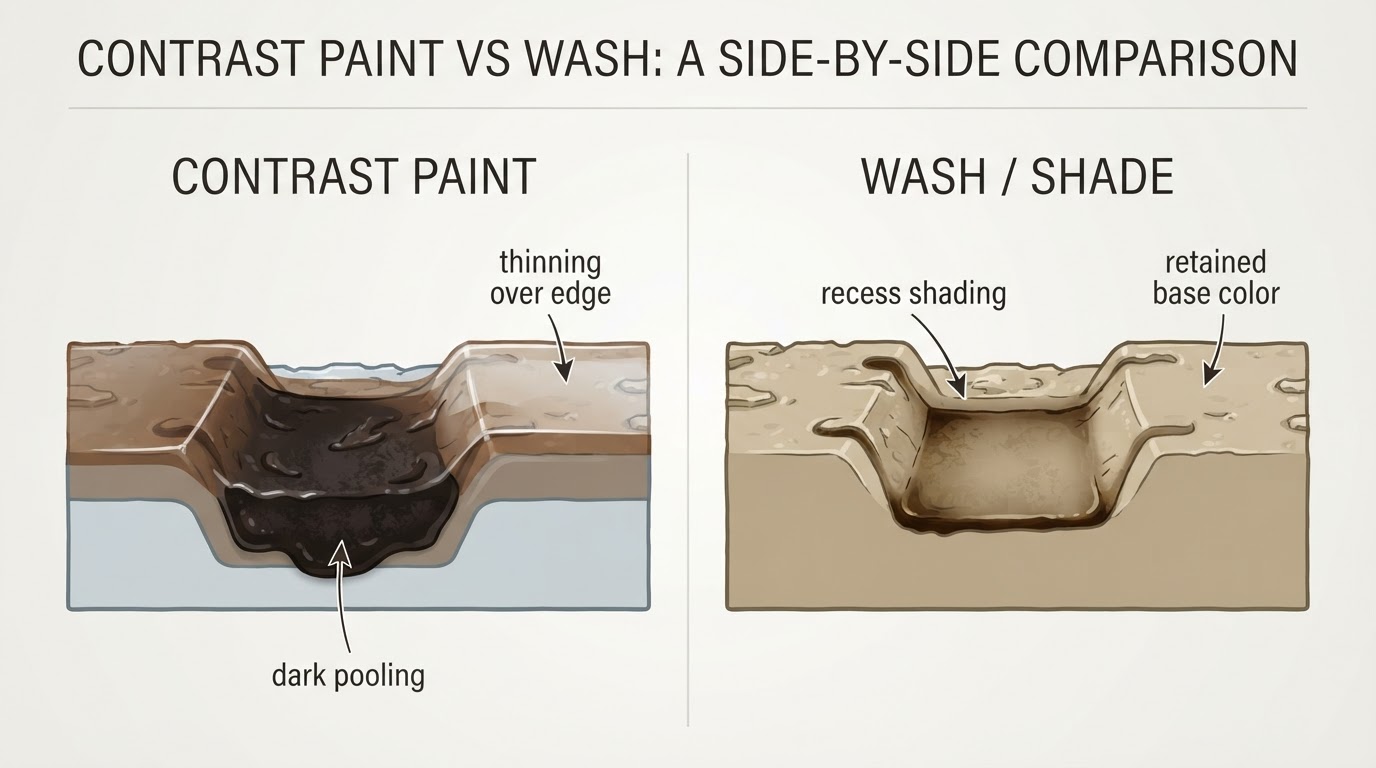
A Shade is a wash first: it is made to run into panel lines, creases and sculpted detail, and it needs a brush load that floods the area without leaving a puddle on flat surfaces. If too much gathers, a clean damp brush can wick the excess away before it dries.
Contrast carries pigment and medium together, so a recess darkens while the raised surface keeps a thinner film of the same colour. That is the effect you want on fur, cloth folds, skin and scales. On a large, flat panel there is almost nowhere for the paint to collect, so the same flow can leave tide marks instead of a gradient. Games Workshop's published Contrast tips point to the countermeasures: a brush loaded until wet but not dripping, long broad strokes instead of many small ones, and no second pass over an area that has started to dry. Contrast also stays wet longer than a standard acrylic, so an area can look finished before it has actually settled.
When a wash over a basecoat is the better call
- You need an exact base colour, or a colour that Contrast cannot reach over the undercoat you have.
- The model is mostly large, smooth surface — armour plates, tanks, vehicles — where there is no texture for Contrast to settle into.
- You are shading metal. Contrast can do this when it is thinned with Contrast Medium, and Games Workshop has illustrated Black Templar mixed with medium shading metals just as well as Nuln Oil while letting some shine through, but a Shade is the conventional, predictable route.
- You have already blocked in base colours and want to finish without repainting the raised areas.
- You are correcting or repairing an existing paint job rather than starting from a bare model.
Contrast-first is the better call when you are starting from a light undercoat, painting textured organic detail, and want colour and shadow in one pass.
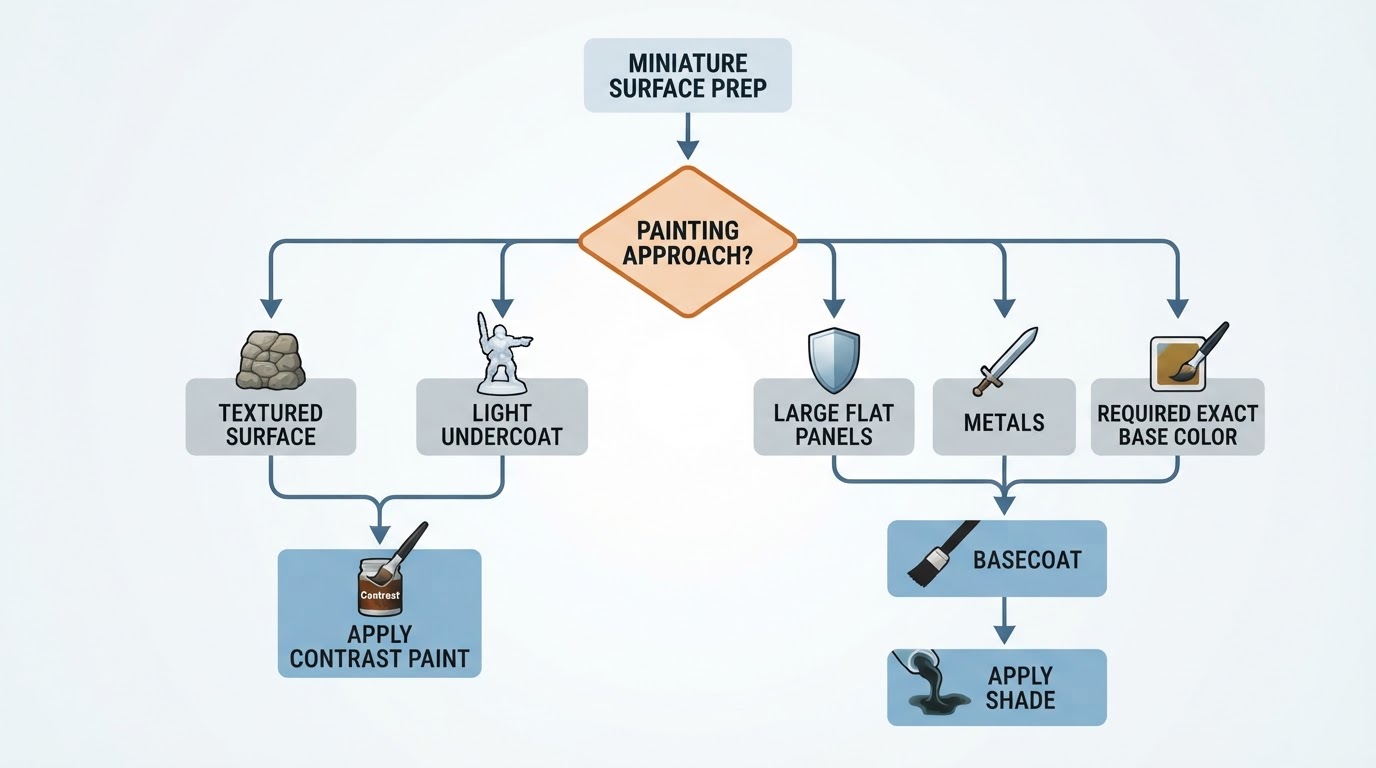
Decision table
Situation | Better choice | Why |
|---|---|---|
Textured areas: fur, cloth, skin, scales | Contrast | The medium settles into texture and darkens recesses while raised surfaces stay lighter |
Large flat panels and vehicle armour | Basecoat, then Shade | Contrast has no recess to collect in and can dry with tide marks |
Metallic surfaces | Basecoat, then Shade | A thin shade deepens the metal while leaving its sheen readable |
An exact, repeatable colour is required | Basecoat, then Shade | An opaque basecoat fixes the colour; a Shade only adds shadow |
Fast coverage across many textured models | Contrast | Games Workshop positions one coat per colour over a light undercoat as enough for Battle Ready |
Correcting a model that is already basecoated | Shade | It adds shadow without repainting the raised areas |
Light undercoat applied, no base colours planned | Contrast | The undercoat is doing the highlight work the paint needs |
Applying each one
Contrast paint, step by step
- Shake the pot thoroughly and work over a light undercoat such as Wraithbone, Grey Seer or White Scar.
- Load a medium brush until it is wet but not forming a drip at the tip.
- Lay the paint on in long, broad strokes, one panel, section or muscle at a time.
- Guide the paint into the recesses as you go, and leave areas that have started to dry alone.
- Let the coat dry fully — it stays wet longer than a standard acrylic — before deciding whether a second thin coat is needed.
- For a softer or more transparent result, mix the paint with Contrast Medium rather than switching products.
A Shade over a basecoat, step by step
- Basecoat the area and let it dry completely; a Shade cannot replace a missing base colour.
- Load a large soft brush and flow the Shade over the area rather than scrubbing it in.
- Let the wash run into the panel lines and recesses, moving it around the model as needed.
- Wick pooling off flat surfaces with a clean damp brush before it dries.
- Let it dry, then rebuild raised areas with the base or layer colour if the tone has shifted.
- Work one area at a time so the wash does not dry before you have moved it where you want it.
Limitations and failure modes
Contrast paint is undercoat-dependent. Over a dark undercoat the translucent film has little to contrast against, and the same pot can look very different over Grey Seer and Wraithbone. Flat surfaces are its weak point, and a heavy application can leave a darker patch or a tide mark rather than a smooth gradient.
Shade paints cannot build colour. They only darken what is already there, heavy application can dull or tint raised surfaces, and an uneven brush load produces an uneven shadow. Neither product replaces the other: one carries the colour, the other only deepens it.
FAQ
Can Contrast paint be used as a wash?
Games Workshop's own painters describe Contrast as both a base-coating paint and a shade, and mixing it with Contrast Medium lets it behave more like a wash — Black Templar thinned with medium has been shown shading metals much as Nuln Oil does. It is still a translucent paint designed to cover a surface, not a purpose-built recess wash.
Does Contrast paint work over a black undercoat?
It can be applied, but it will usually show much less of its intended light-to-dark contrast over black. Grey Seer, Wraithbone and White Scar are light undercoats Games Workshop recommends. Test a spare part if you want a very subtle tint over dark primer.
Can I apply a Shade over Contrast paint?
Yes, once the Contrast coat is fully dry. A Shade can deepen recesses but may also darken raised surfaces. Keep the coat thin and wick away pooling on flat areas so the two effects do not merge into one muddy tone. For a different comparison, see our Contrast versus Speedpaint guide.