The short answer
If you want the deeper of the two blacks, start with Black Legion. Warhammer names it for armour, hair, weapon casings and cast iron. If you want to try the original Black Templar shade, test the two paints side by side over your own primer. That comparison matters more than an unverified promise about how either pot will look on every surface.
What the official sources actually say
Warhammer's official paint spotlight describes Black Legion as darker than Black Templar, with a rich, clean black tone, and names armour, hair and thinned-down washes over metals as its uses. It presents Black Templar as the earlier option and Black Legion as a bolder alternative.
The official range article adds two details: it recommends Black Legion for weapon casings and cast iron, and describes Contrast paints as tinting surfaces. It names White Scar, Grey Seer and Wraithbone as compatible light undercoats.
The supported distinction is darkness: Black Legion is officially described as the darker of the two. How much primer shows through on your model is a practical test, not a universal property we can infer for Black Templar from that wording alone.
Which black for which job
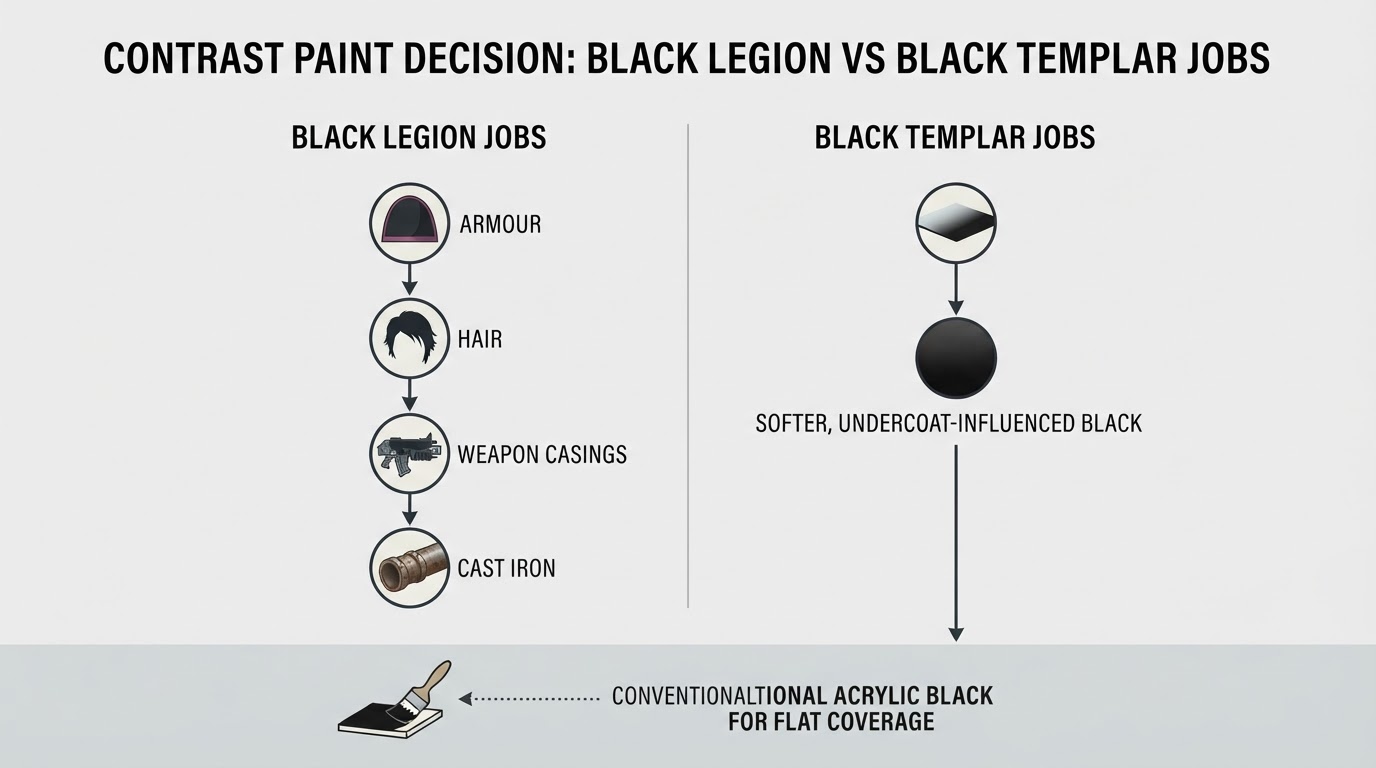
Job on the model | Better starting pot | Why, per official copy |
|---|---|---|
Main armour that must read black | Black Legion | Called darker, with a rich, clean black tone, and named for armour |
Hair, weapon casings, cast iron | Black Legion | Named for hair, weapon casings and cast iron |
A dark wash over metals | Black Legion | Official copy says it can be thinned down for a really dark wash over metals |
An alternative to Black Legion's deeper tone | Test Black Templar | The earlier black Contrast; compare it on your actual undercoat rather than assuming a fixed transparency |
Flat, uniform black and later touch-ups | A conventional acrylic black | Contrast paints are built to tint and shade, not to replace an opaque black for flat coverage |
The bottom row answers the Abaddon Black question: for conventional, fully opaque acrylic black, a standard black such as Citadel's Abaddon Black remains the simpler tool, and neither Contrast pot is a straight swap for it. Treat Black Templar and Black Legion as two jobs inside a Contrast workflow, not as replacements for the flat blacks already on your rack.
Black Legion is the deeper of the two according to Warhammer. If you need a different finish, try controlled thinning with Contrast Medium or an additional fully dry coat on a test piece first; either change can affect the final appearance.
How to test both blacks on a spare piece
Swatches from someone else's bench may not match your light, undercoat or thinning. A small comparison on spare pieces gives a more relevant answer than guessing from a photograph:
- Undercoat two spare pieces the same way you undercoat the army. White Scar gives the brightest start; Grey Seer and Wraithbone are the cooler and warmer options in the range.
- Let the undercoat dry completely. Contrast responds to what is underneath it, so a damp or uneven base coat will show through.
- Apply Black Legion to one piece and Black Templar to the other in a single generous, even pass. Do not go back over wet paint - let it do its own shading.
- Let both pieces dry fully, then compare how much undercoat still reads through, how dark the recesses went, and whether the finish looks clean rather than patchy.
- Check both pieces under your usual painting light, and note which pot reads as black and which reads as a tint at table distance.
- Keep the winning piece as a bench reference. Add a second controlled coat only after the first is dry, and note what changed.
For the broader distinction between a Contrast paint and a conventional wash, see our Contrast paint vs wash guide.
Limitations: when each black is the wrong pick
- Black Templar is less certain if your goal is the deepest black across a whole army. The official spotlight reserves the darker, clean black description for Black Legion, so start by testing that pot.
- Black Legion may be too dark for a particular undercoat or highlight plan. It also will not paint edge highlights for you; add those separately if the scheme needs them.
- Neither pot suits flat coverage, precise touch-ups, or a large surface where you need total opacity.
- Both are substrate-dependent. Over a dark undercoat the difference narrows, and over metal the result changes again - which is why the honest recommendation is to test first.
FAQ
Is Black Legion darker than Black Templar?
Yes. The official paint spotlight describes Black Legion as darker than Black Templar, with a rich, clean black tone, and calls it a bolder alternative.
Can I use both on the same miniature?
Yes. You can test Black Legion on the parts that need the deepest black and Black Templar where you prefer its finish. Check the same primer and lighting before committing a whole unit.
Do I need a special undercoat for either one?
The range is designed around light undercoats - White Scar, Grey Seer and Wraithbone. Those are the surfaces the official copy describes, so they are the fairest way to compare the two blacks. On a dark undercoat, expect different results.
Sources
- 10 dazzling new Contrast paints and how to use them - the official paint spotlight that compares Black Legion and Black Templar.
- A new era of paints: new Contrast colours, reformulated Shades and our best white spray ever - the official range article covering Black Legion, Contrast tinting and its undercoats.