The Material Comes Before the Method
Citadel kits have been produced in different materials over the years, and a single collection can mix them: plastic in current ranges, white metal in older collections, resin in Forge World releases and conversions. Mixed builds — a resin torso on a plastic body, a metal arm on a resin base — are common.
That matters because a cleaner that is harmless on one material can soften or dissolve another. Treat "which material is this?" as the first step of every stripping job. Check the kit's packaging, the manufacturer's product page or the older catalogue listing. If a part's material is unknown, treat it as the most sensitive material present.
Read the Label and the SDS Before You Pour Anything
Paint removers are chemical products: the label and safety data sheet are the authoritative source for what they can touch and how to handle them. OSHA's Hazard Communication Standard exists so that manufacturers convey hazard, precaution and first-aid information in a standard label and a 16-section SDS (osha.gov/hazcom).
Before buying or opening a cleaner, read:
- the hazard and precaution statements, and material-compatibility guidance;
- the stated first-aid measures and required protective equipment;
- mixing and storage warnings.
Do not improvise chemistry. The NIOSH Pocket Guide for isopropyl alcohol, for example, lists incompatibilities with strong oxidizers, acetaldehyde, chlorine, ethylene oxide, acids and isocyanates (NIOSH Pocket Guide). Mixing cleaners can produce heat, fumes or a reaction that neither product's label anticipated, so use one product at a time, as directed.
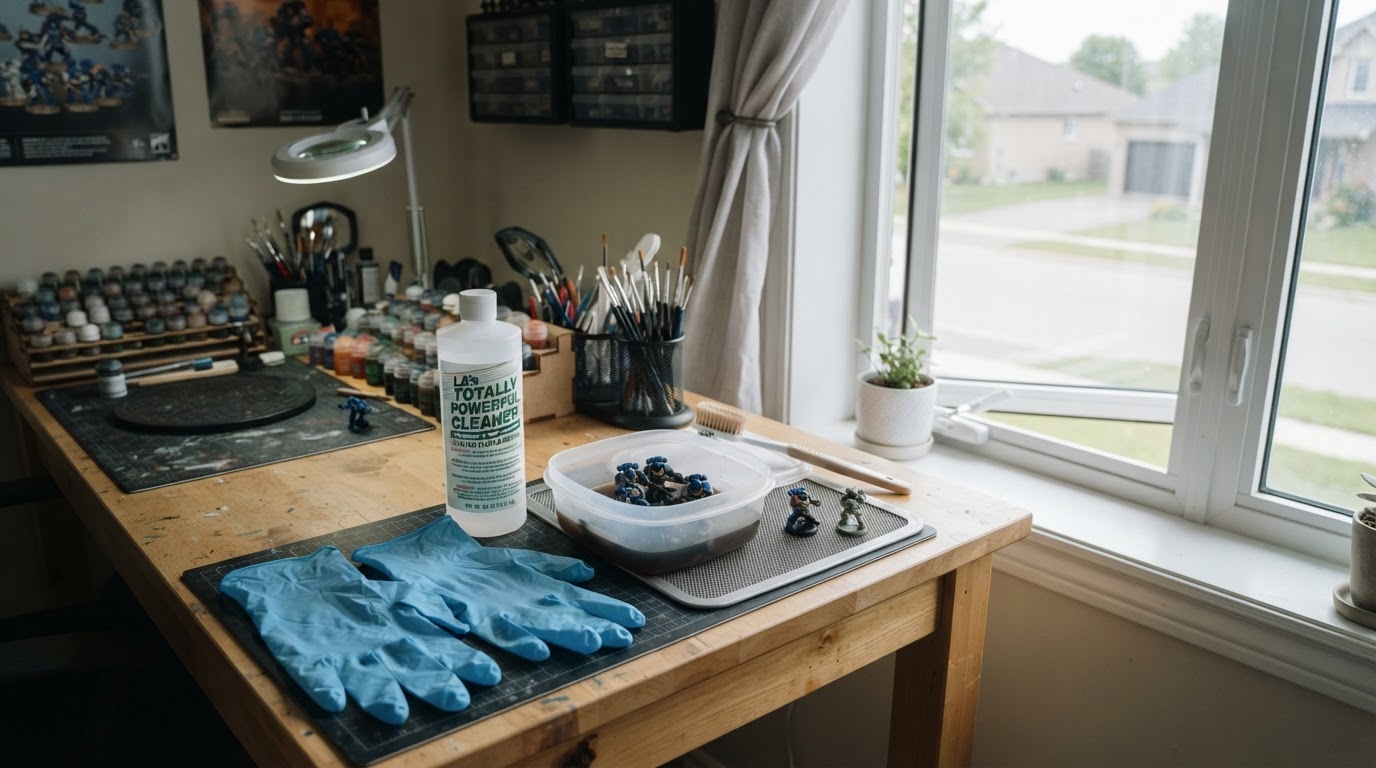
Ventilation and gloves are not optional extras. NIOSH lists inhalation and skin or eye contact as exposure routes for isopropyl alcohol, with effects including eye, nose and throat irritation, drowsiness, dizziness, headache and dry, cracking skin, and it recommends preventing skin and eye contact. Work in a well-ventilated space, wear chemical-resistant gloves and eye protection, and keep solvent vapours away from ignition sources: the same guide gives isopropyl alcohol a flash point of 53°F and classifies it as a Class IB flammable liquid. Never heat a solvent or a model to speed the process up.
Test on a Hidden Area First
A label's compatibility claim is a starting point, not a guarantee for your model. Test first:
- Pick an inconspicuous area — the underside of a base, the inside of a cloak, a spot hidden by an arm or backpack.
- Apply a small amount of the cleaner for an interval permitted by its label; do not exceed the manufacturer's instructions.
- Wipe or rinse as directed, then let the spot dry.
- Inspect: paint should lift without the surface turning soft, tacky, chalky or glossy-melted, and without fine detail blurring.
If anything looks wrong, stop and switch product, approach, or decide to re-prime.
A Material-by-Material Decision Matrix
Confirm every cell against the manufacturer's material guidance and the cleaner's current label and SDS.
Model material | Check first | Safer direction | Stop signs |
|---|---|---|---|
Plastic (polystyrene) | Kit material statement and cleaner label | Mildest product whose label names the plastic as compatible; short, checked contact | Surface dulls, softens, or detail softens |
Metal (white metal) | Product label; whether parts are glued or pinned | Solvent-based products only if the label confirms metal use; soft brush agitation | Paint refuses to lift, or glue joints fail |
Resin | Manufacturer's handling guidance and label compatibility | Short, carefully timed contact; test on a sprue or hidden area | Any softening, bending or surface tackiness |
Mixed or unknown | Identify every part; find the most sensitive material | Treat the whole model as the most delicate material present | Uncertainty itself — stop and reassess |
Step by Step Through a Controlled Strip
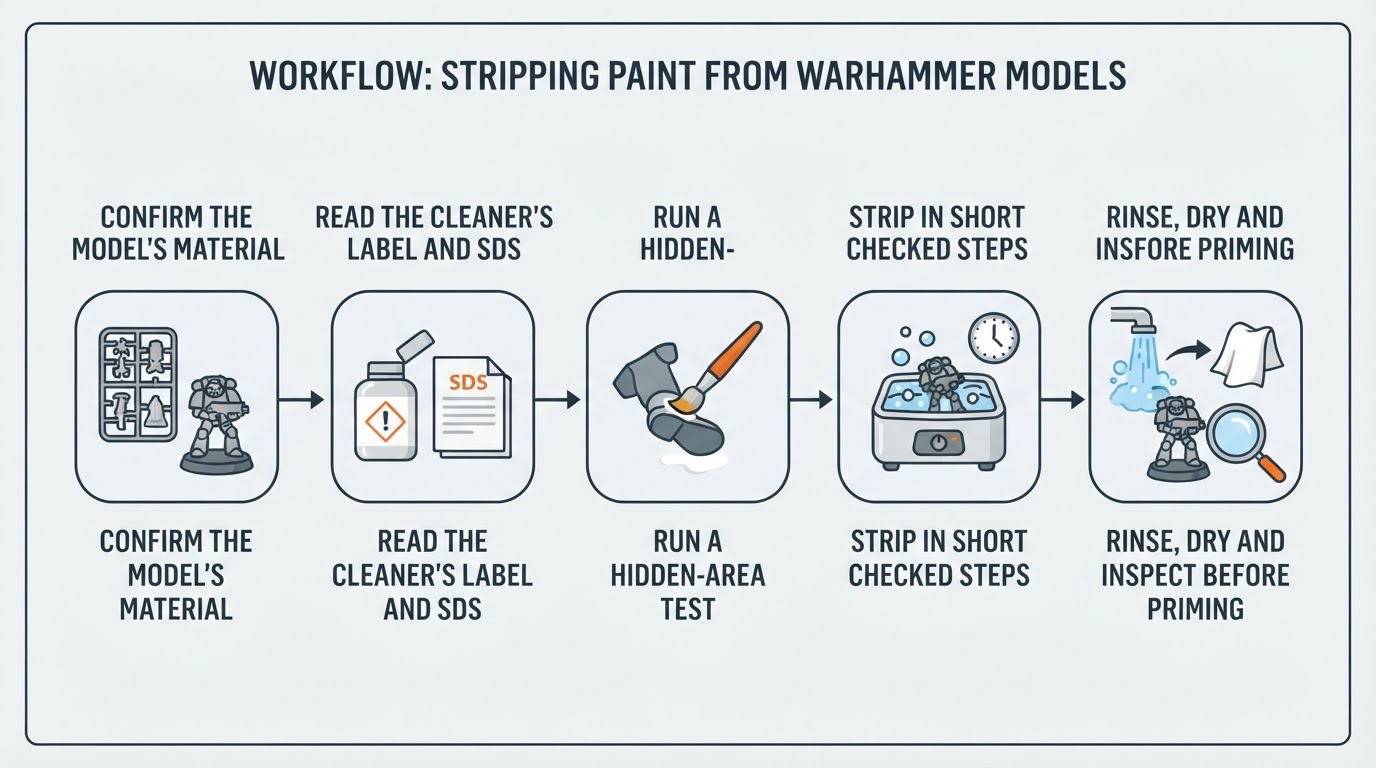
- Note the material and remove anything you do not want exposed — basing material, decals, fragile conversions.
- Read the label and SDS, and set out gloves, eye protection and a ventilated workspace away from ignition sources.
- Run the hidden-area test and note the exposure time that worked.
- Apply the cleaner as the label directs, starting with a small area.
- Check frequently. Lift paint with a soft brush only if the label allows it; never grind or scrape softened detail.
- Rinse exactly as directed; residue in crevices can keep working.
- Dry the model completely, then inspect it under good light.
- If detail has softened, stop. More solvent will not restore it.
When Re-Priming Is the Safer Choice
Stripping is not automatically the right answer. If the paint is thin, smooth and holding detail — a single well-behaved layer of acrylic, for instance — a fresh coat of primer is often safer than a chemical bath, especially on delicate resin or fragile conversions. Re-priming preserves the original surface and avoids the risk that the cleaner attacks the model.
Strip instead when the paint is thick or lumpy, filling in detail, flaking, or too glossy for primer to key to. Re-priming over flaking or heavily textured paint traps the problem under a new coat, and a thick layer can bury detail further.
Limitations to Keep in Mind
- There is no universal solvent, soak time or compatibility list. Products are reformulated, and labels change.
- Older models may carry putty, superglue or unknown conversion materials that react differently from the miniature itself.
- Long, unattended soaking increases risk; short, checked exposure tells you more.
- Manufacturer guidance outranks hobby-forum consensus when the two disagree.
FAQs
Can I use isopropyl alcohol on any Warhammer model? No single answer covers every kit. Isopropyl alcohol is a flammable solvent with documented exposure limits and skin and eye irritation risks, and some resins are more sensitive than plastic or metal. Check the manufacturer's material guidance, read the cleaner's label and SDS, and run the hidden-area test before committing a model.
Does a longer soak strip stubborn paint faster? There is no universal soak time. Longer contact gives a cleaner more time to reach the material underneath the paint, so treat the label's timing as your ceiling, check at short intervals and stop once the surface is clean enough to prime.
Can I mix cleaners or warm the solvent to speed things up? No. Mixing products can create reactions their labels never anticipated, and warming a flammable solvent raises vapour and fire risk. Change approach instead: a different product or re-priming.
If your main problem is fresh paint wearing off during handling, see our separate guide to Warhammer paint rubbing off; stripping the entire model may not be necessary.