Start With the Material, Not the Solvent
Removing cured super glue is a material-safety decision before it is a cleaning task: the debonder acts on the adhesive but lands on the model underneath, which is usually more fragile.
BSI's Un-Cure product page shows how narrow the claim usually is: it says the debonder softens cured cyanoacrylate, or CA, and it warns that the product will mar most plastics. That is guidance for one product on the substrates its maker tested, not a statement about any other solvent on your resin, primer, or paint.
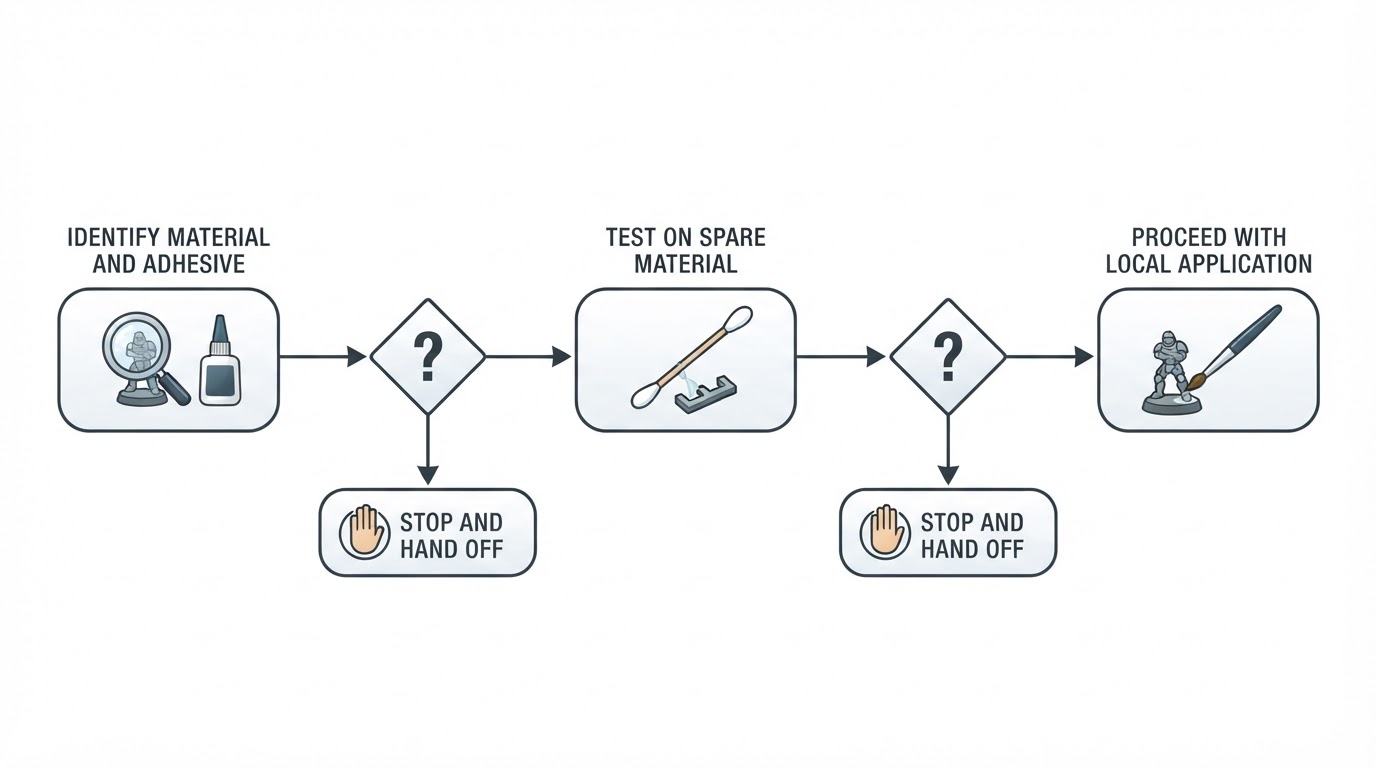
Identify three things before you touch the model:
- The material: polystyrene, resin, metal, or a mixed assembly. If you do not know, treat it as the most sensitive option.
- The adhesive: CA super glue, or a polystyrene solvent cement that has fused the surfaces. These are different failures. See how plastic glue and super glue behave differently on miniatures.
- The finish: bare plastic, primer, or a full paint job. A product that is tolerable on bare plastic may still lift paint beside the joint.
What a CA Debonder Can and Cannot Do
A CA debonder is formulated to soften cured cyanoacrylate so a bond can release; BSI describes Un-Cure that way while warning about marring plastics. Read the product page and its SDS before you use anything on a finished piece, and follow that label's method rather than a generic recipe.
Two limits matter most:
- It does not reverse a polystyrene solvent weld. Solvent cement fuses the surfaces rather than sitting on top of them, so there is no cured adhesive layer to soften.
- No universal contact time exists. Label, material, adhesive thickness, and amount applied all change the result. Long immersion is not a safer version of a short, local application.
Test on Spare Material — as a Screening Step
For plastic, resin, painted, or mixed assemblies, leave the chemical off unless compatibility is established: a manufacturer substrate list naming that material or a recommendation from the maker. An offcut that survives a trial is a screening observation, not proof a valuable miniature is safe; offcuts and models differ in batch, cure, primer, and paint layers.
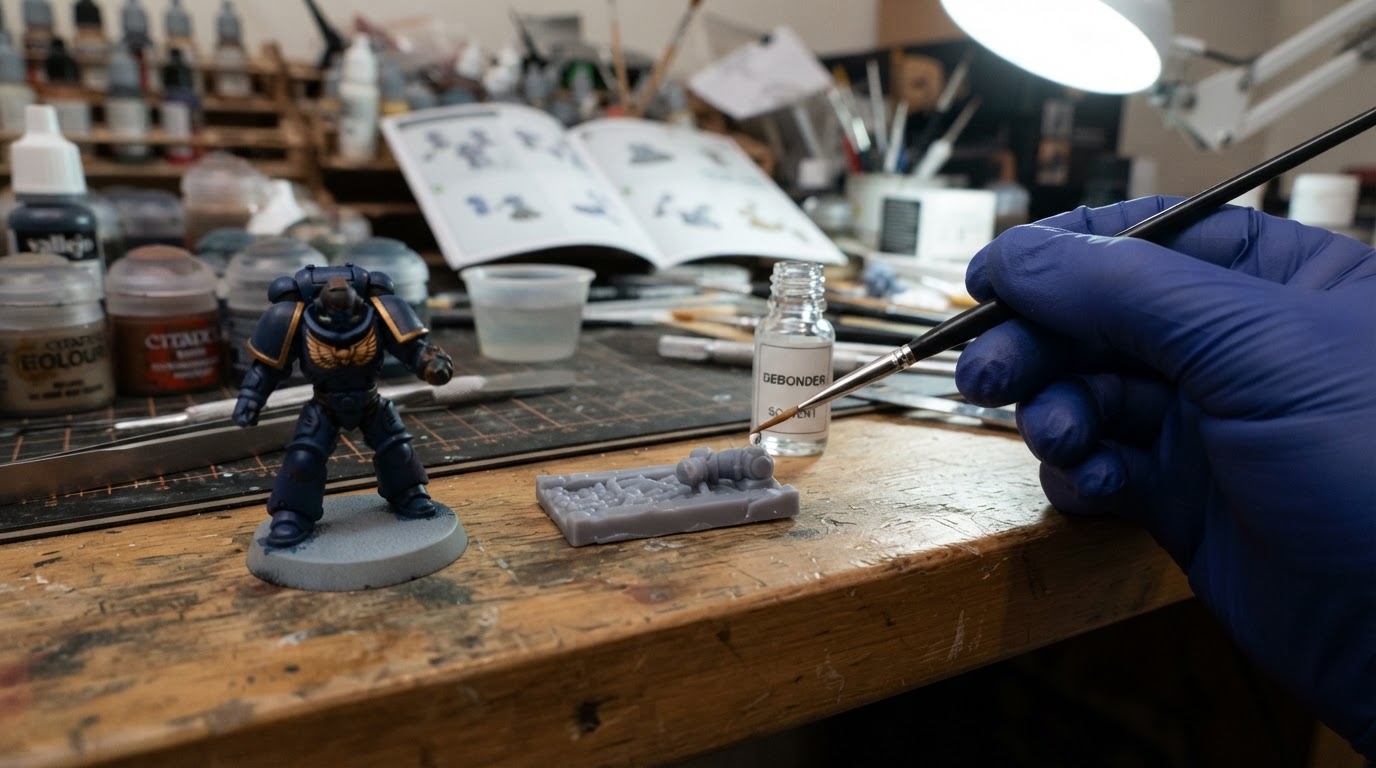
If you have a compatible product and a matching test piece, inspect visually rather than handling the softened area:
- whitening, hazing, or a change in sheen where the product touched
- fine crazing or cracks at the joint edge
- paint lifting, wrinkling, or blistering beside the joint
- a crisp edge that now looks rounded or slumped
Stop there. Do not apply more product, do not move to a longer soak or a stronger solvent, and do not press on a softened area to judge how far it has gone. Handling, disposal, PPE, and ventilation come from the label and its safety data sheet.
White residue around a CA joint is a separate problem worth diagnosing rather than scrubbing away; see why super glue can leave white frosting on miniatures.
Where to Stop and Hand Off
Stop and get help when the miniature is valuable, the part is thin or translucent, the material is unknown, the assembly mixes resin and polystyrene, or paint is already lifting. For a model you care about, the practical answer to how to remove super glue from miniatures is often to leave the joint alone.
A failed chemical attempt is not a reason to escalate to soaking, freezing, or cutting; those moves shift risk from the joint to the rest of the model.
A Practical Decision Table
What you have | What the adhesive is | Sensible first move |
|---|---|---|
Unpainted polystyrene kit | Polystyrene solvent weld | A CA debonder will not undo the weld; leave it or use a mechanical approach |
Painted polystyrene | CA super glue | High risk: no chemical unless compatibility is established |
Resin miniature | CA super glue | One offcut result is a screening observation only; formulations vary |
Metal part | CA super glue | Usually tolerant, but keep the product off nearby paint and basing |
Mixed-material assembly | CA super glue | Work to the most sensitive material; default to no chemical if unverified |
Set a Completion Standard
A successful removal ends with the adhesive released, the surrounding surface unchanged in color and texture, and no paint lifted at the joint edge. If the part comes free but the plastic has softened or the paint has wrinkled, the job is not finished: the damage is now the problem, waiting does not resolve it, and repainting over it does not restore it.
If the material or the label leaves any doubt, leave the joint alone or put the job in front of someone who works with that material.