Key Answers: How to Be a Great Dungeon Master
A great dungeon master keeps preparation light, follows the players' choices, and treats communication as the core skill; maps, minis, and house rules are support, not the job.
- Preparation: Write one page — the current situation, one NPC who wants something, and three names you can improvise with — then stop.
- Rules: Learn the basic check, know how a turn works, and look up the rest; you can run a complete session while you are still learning the game.
- Running the table: Answer player ideas with "yes, and" or "yes, but," keep scenes short, and end on a decision the players want to make.
- Managing players: Agree on tone and expectations early, rotate the spotlight, and settle problems between scenes instead of mid-argument.
- Tools and minis: Dice, paper, a way to mark positions, and a few monster figures are enough for session one; terrain and painted armies come later.
Preparation: One Page, Then Stop
A great dungeon master prepares one page and stops, because the players — not your notes — decide what happens next.
The one-page prep sheet has three lines:
- The situation. One sentence: where the players are and what is about to happen. "The party stands outside a flooded mine, and the water is still rising."
- One active NPC. A single character who wants something and will act if the players ignore them. One motive, one method, no full stat block.
- Three names. An NPC name, a place name, and a thing name. This is your improvisation fuel for the moment players ask about someone you never planned.
Everything beyond those three lines — maps, scripted dialogue, stat blocks for every bystander — is optional, and most of it will never reach the table.
Completion check: you are ready when you can say, in one sentence each, what is happening, who is pushing back, and what happens if the players do nothing. If you can answer those three, you can run the session.
Light prep works because unplayed notes are dead weight, and players break careful plans by design. A full script also tempts you to steer the table back toward your plan, which is the fastest way to make a session feel like homework.
Running the Table: Pace, Stakes, and Saying Yes
At the table, a great dungeon master says yes to player ideas, keeps every scene pointed at the next decision, and lets failure move the story instead of stopping it.
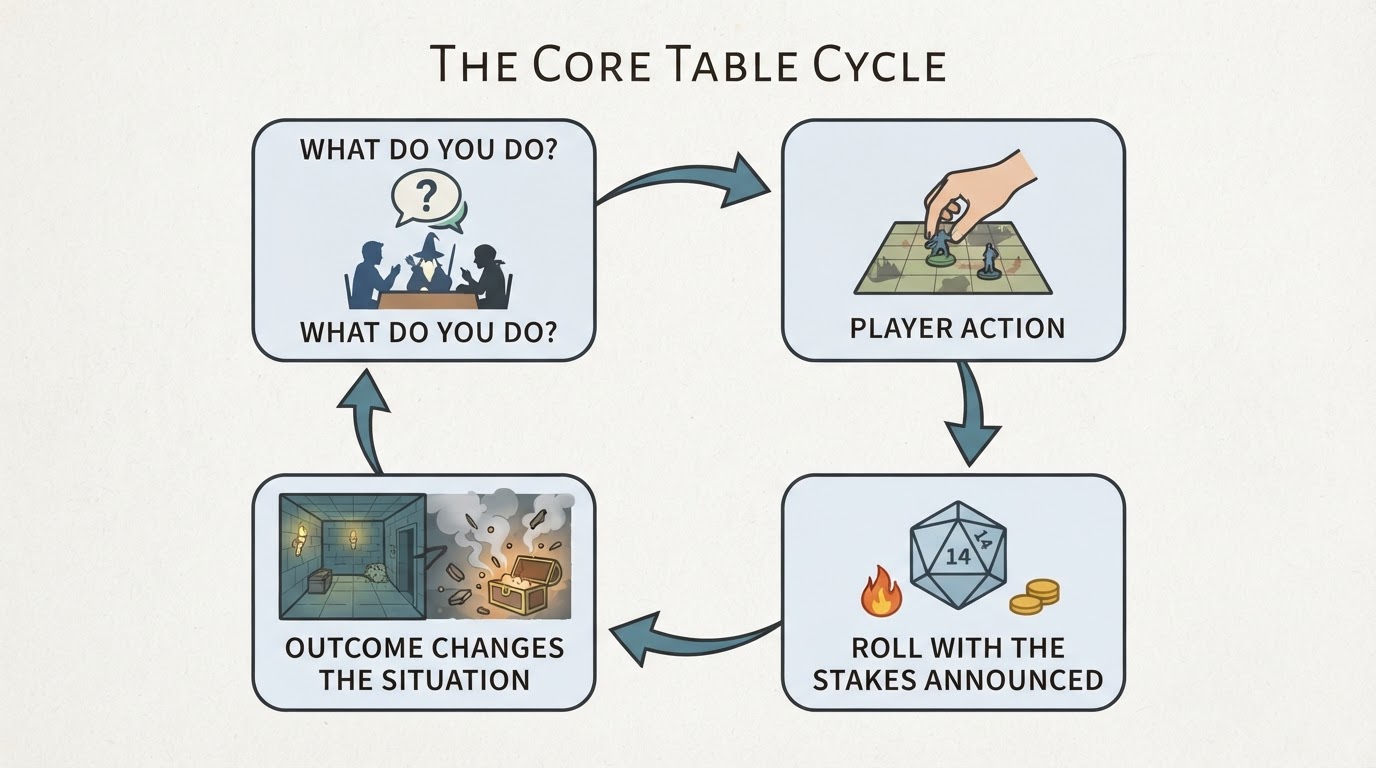
Say yes, with a cost. When a player proposes something unexpected, answer "yes, and" if it fits, or "yes, but" if it needs a price — a risk, a resource, a complication. Save "no" for ideas that break the table or the world's basic logic. Players remember the moment they were allowed to try something.
Pace by decisions, not by minutes. A scene is finished when the interesting decision has been made. Cut travel, shopping, and bookkeeping, and skip ahead to the next choice. If a scene has run for a while without a new decision, that is your cue to ask, "What do you do?"
Make failure interesting. A missed roll should change the situation rather than end it: the lock opens but the alarm sounds; the climb succeeds but the rope frays. Consequences that create new choices keep the table engaged.
Rules at the table. You need one loop: the player describes an action, you decide whether the outcome is uncertain and meaningful, and if it is, you announce the stakes and call for a roll. State the price before the dice land — "a 15 or better and you make it across" — then resolve. When you do not know a rule, make a fair call, keep it consistent for the rest of the session, and look it up between games. Consistency matters more than being right in the moment.
Managing Players: Communication Beats Rules Mastery
The skill that separates a good dungeon master from a great one is communication: set expectations before the first roll, share the spotlight, and handle problems away from the heat of a scene.
Start with expectations. Before play, spend ten minutes on tone, content boundaries, and what each person wants from the game. Agree on how rules disagreements get settled — the DM calls it during play, the group reviews it after — so no scene turns into a debate.
Rotate the spotlight. Track who has acted and who has not, then ask quieter players directly: "What is your character doing while this happens?" A dominating player is usually just filling silence, and a direct question is the simplest fix.
Handle problems between scenes. If someone is frustrated, pause briefly, make a call, and keep going; then talk it through after the session, when nobody is invested in winning the moment. End with one feedback round: what worked, and what dragged. Change one thing next time.
Tools and Minis: What You Actually Need for Session One
For a first session you need dice, something to write on, a way to show who is standing where, and a few monster figures; miniatures, terrain, and painted armies are upgrades, not entry requirements.
- A surface you can mark. A vinyl battle mat with a wet-erase marker, or a sheet of paper with a hand-drawn grid. Exact distances matter only once a fight starts.
- A handful of minis. Player characters and the monsters you expect to use. If you run short, paper standees or spare dice work as proxies — the table reads position, not sculpt quality.
- Beginner gear. A set of dice, index cards for names and turn order, a pencil, and a printed copy of the basic rules. A screen is optional; rolling in the open is often more exciting for new players.
- Scale and consistency. Buy within one scale family so your figures look right beside each other, and give larger creatures larger bases. Consistency across the table matters more than any specific measurement.
- Unpainted is playable. Plastic straight out of the box works fine. Painting is a separate hobby layer you can add once the table is running smoothly.
FAQ: Follow-Up Answers by Intent
Most follow-up questions about running a game land in four groups — preparation, the table, players, and minis — and each answer below works as a standalone reply.
Preparation
How long should I prep for a session? Long enough to fill one page. If you are still writing after that, you are planning the players' choices for them, and most of that work will never reach the table.
What if I do not know what to prepare? Write the situation, one NPC's goal, and three names. If you can describe the current problem and who wants something from the players, you have a session.
Do I need to read all the rules first? No. Learn the basic check, how a turn works in combat, and how to look things up quickly. The rest you will absorb by running games.
Running the Table
What do I do when players ignore my plan? Follow them. Ask what their characters are trying to achieve, then let the world respond. Your plan is a starting position, not a script.
How do I keep a session moving? End scenes at the decision point, cut travel and shopping, and ask "What do you do?" often. Momentum comes from frequent choices.
What if I get a rule wrong? Make a fair call, keep the same call for the rest of the session, and check the book between games. Nobody remembers a small rules slip; they remember a table that stalled.
Managing Players
How do I handle a player who dominates? Track who has acted, then ask the quiet players directly. Spotlight management is part of the job, and a direct question is usually enough.
How do I deal with disagreements at the table? Make the call, keep playing, and discuss it after the session. Rules debates in the middle of a scene cost everyone the game.
How do I know my players are having fun? Ask them at the end of the session, in one round: what worked, what dragged. Then change one thing next time.
Tools and Minis
Do I need miniatures to run a game? No. Theater of the mind works, and paper standees or spare dice work as markers when you need exact positions.
What is the minimum gear for session one? Dice, paper, a way to mark positions, and a few monster figures. Everything else is optional.
What scale should I buy? Stay inside one scale family so your figures look consistent together, and use larger bases for larger creatures. Consistency matters more than the exact size.
Can I play with unpainted miniatures? Yes. Unpainted plastic is fully playable, and painting is a hobby you can pick up later.
Your First Session, Start to Finish
A first session runs in three phases — before, during, and after — and the finish line is simple: the players want another one.
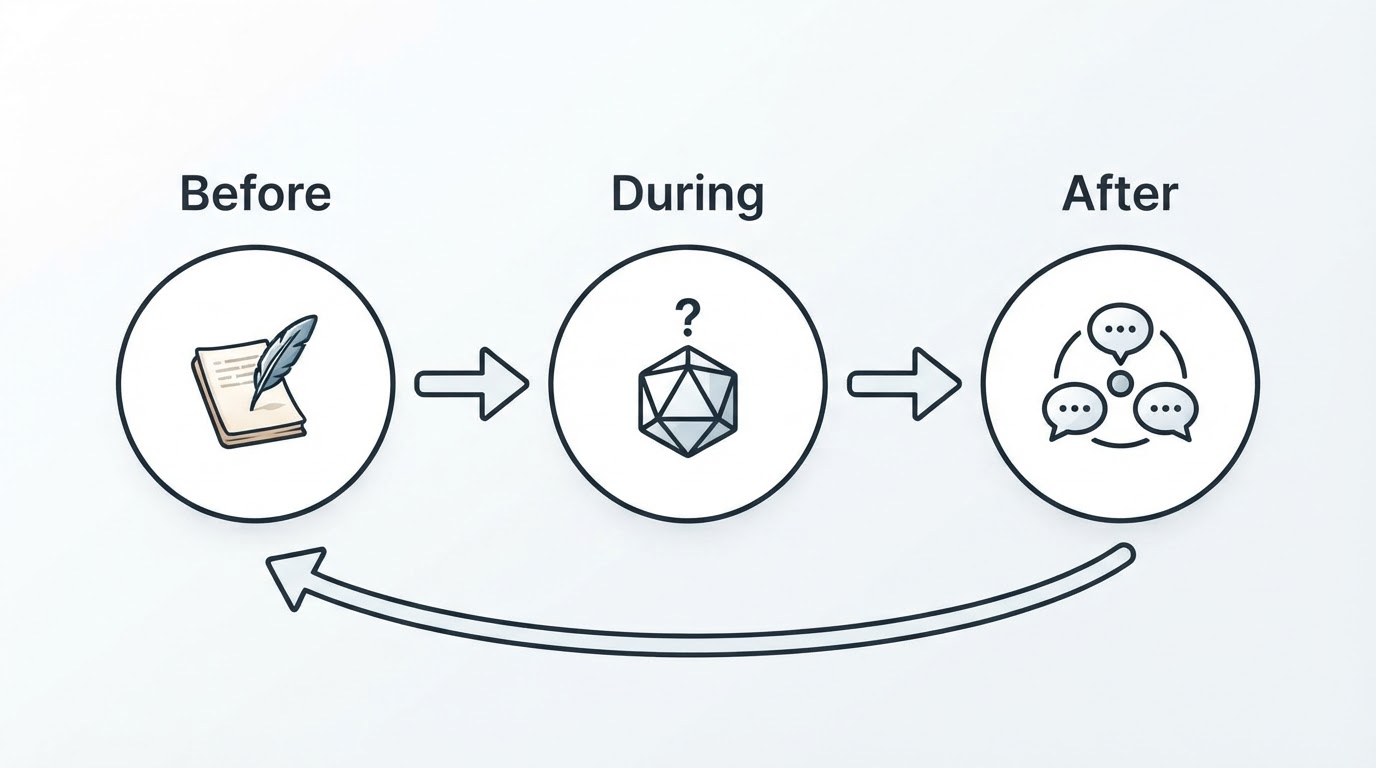
Before you sit down (one page): write the situation, one NPC who wants something, and three names. Confirm that the players know the tone and the start time. Put the dice, the prep sheet, and a few minis on the table.
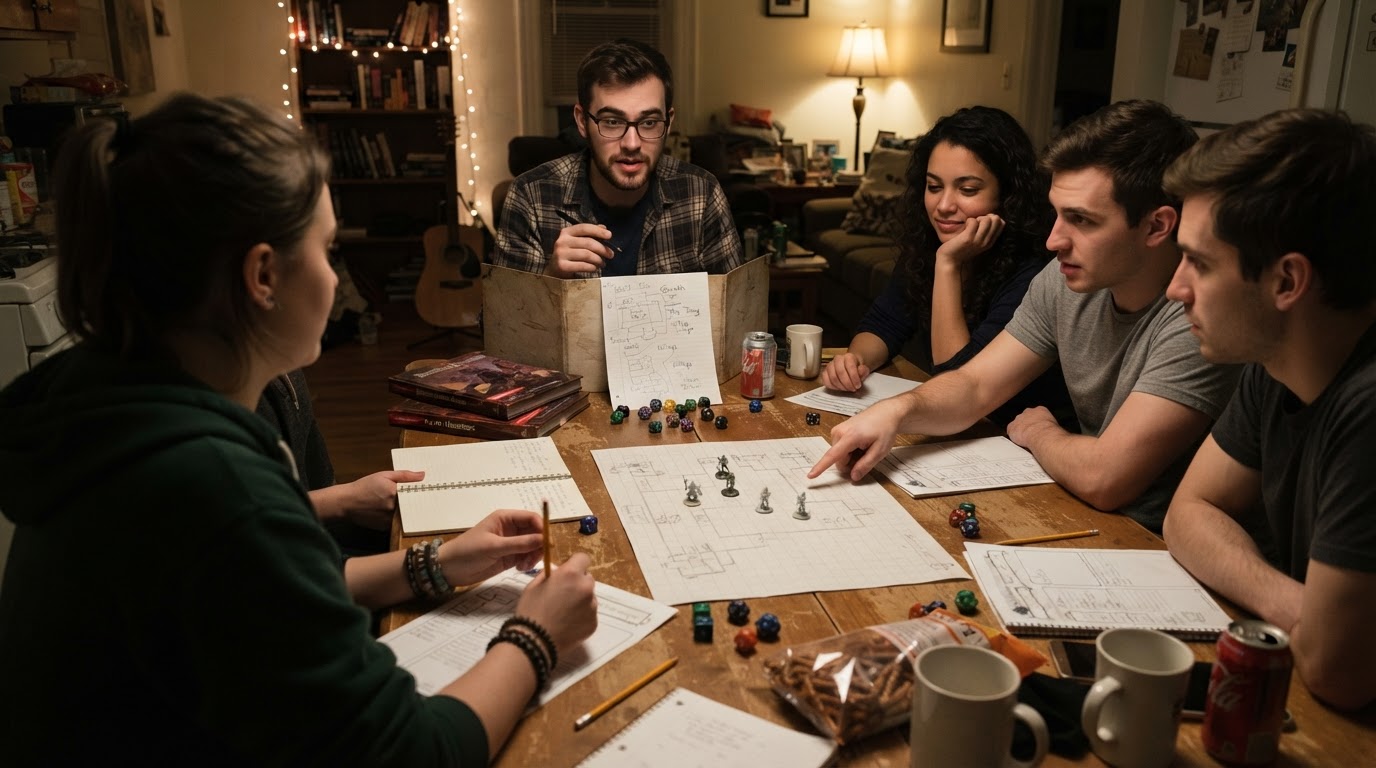
While you run (keep asking): describe the situation, ask "What do you do?", say yes with a cost, resolve only what is uncertain and meaningful, and cut to the next decision. Stop at a moment the players want to continue from.
After the session (one round): ask what worked and what dragged, note one change for next time, and thank the table. Then update your prep sheet for the next game.
Completion standard: the session worked when the players made meaningful choices, the story moved, and everyone knows where the next game starts. You do not need a perfect session — you need a table that wants another one.