Key answers
Question | Short answer |
|---|---|
What is 'Eavy Metal? | Games Workshop's classic studio paint style: clean basecoats, crisp edge highlights, and deep, saturated shading that reads clearly on the table. |
Are official printed guides still available? | Availability depends on the exact title and edition. Identify the book you want, then check the publisher's or a retailer's current listing instead of assuming a status. |
Can you still learn the style? | Yes—from reachable official technique articles, creator-published tutorials, and community paint-scheme archives that teach the same techniques. |
What should you avoid? | Treat a file that is not offered by the publisher or another authorized source as unverified, and use official listings when you want the full book. |
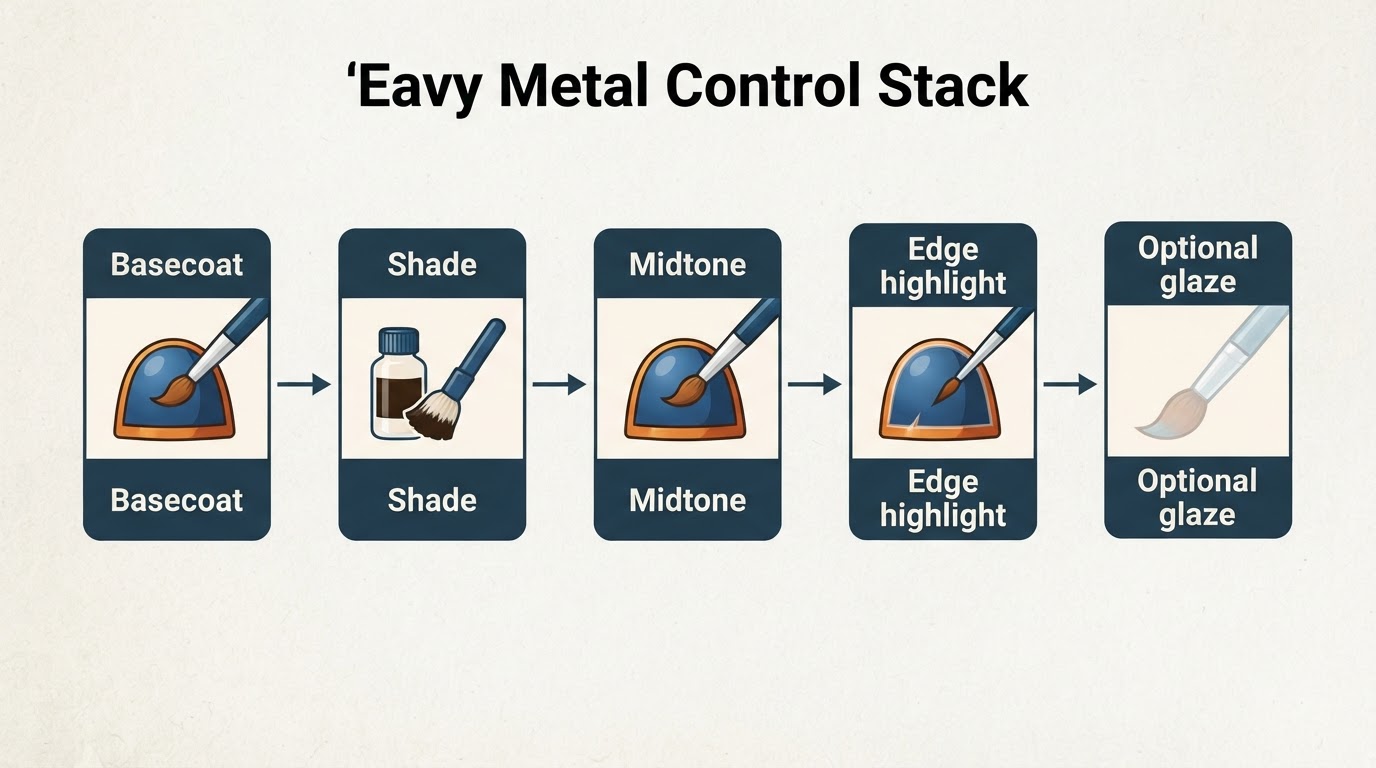
What is the core technique loop? | Solid basecoat → controlled shade/recess work → midtone recovery → crisp edge highlights → optional glaze/filter for color unity. |
How do modern paints fit? | Use current acrylic ranges with similar roles (base, layer, shade, glaze). Match the role of each step, not a single historic pot name. |
What 'Eavy Metal style is
'Eavy Metal is the classic Games Workshop studio painting look built for tabletop readability. Clean basecoats, crisp edge highlights, and deep saturated shading define it more than any single "secret" product. The finish aims to keep armor plates, cloth folds, and weapon edges legible from arm's length, even under ordinary room light.
Historically, the name attached to Games Workshop's studio painters and to the printed technique books and magazine features that taught their methods. Those books helped a generation of hobbyists, but they were commercial products. When people search for an eavy metal painting guide pdf, they are usually trying to recover that teaching—not just a file name.
Three practical truths matter more than nostalgia:
- The look is a technique system, not a download. If you can basecoat cleanly, shade recesses, recover midtones, and place thin edge highlights, you are already inside the style.
Official printed guides are title-specific. Availability and price vary by title, edition and region, so identify the exact book you want and check the publisher's current listing rather than assuming a status from an old forum post.
Learning paths still exist. Free creator tutorials, authorized digital releases when offered, community recipe archives for box-art color breakdowns, and modern paint-range guides can teach the same control skills as a full book.
If your goal is "paint like the box," prioritize control and contrast over hunting a specific vintage PDF.
Core techniques that create the look
The 'Eavy Metal look is produced by a short, repeatable stack of controls. Master these before chasing special effects.
1. Clean, opaque basecoats
Start with a smooth prime and thin, even base color. The studio look fails early when basecoats are streaky or translucent on large plates. Thin paint enough to flow, then build coverage in two or three passes rather than one heavy coat.
Completion check: from about 30–40 cm away, large armor panels look solid and even, with no primer freckles and no brush ridges.
2. Deep, placed shading
Shading is not "wash everything brown." Place darker value into recesses, under plates, inside cloth folds, and where forms turn away from light. A controlled shade or recess color increases separation between shapes. Many painters still use a dark wash as a first pass, then reinforce only the deepest lines.
Completion check: recesses read darker than midtones, and panels still keep a clear mid value—not a muddy overall tint.
3. Midtone recovery
After shading, re-establish the main color on raised surfaces. This step is easy to skip and is one reason beginner minis look "stained" instead of "studio clean." Recovering the midtone restores saturation and sets a stage for highlights.
Completion check: the eye can name the main color of each major material again (blue armor still reads blue, red cloak still reads red).
4. Crisp edge highlights
Edge highlighting is the signature readability move: a lighter value on the sharpest outer edges, corners, and raised rims. Keep the line thin. Thick chalky edges look toy-like; broken, cautious lines look more controlled.
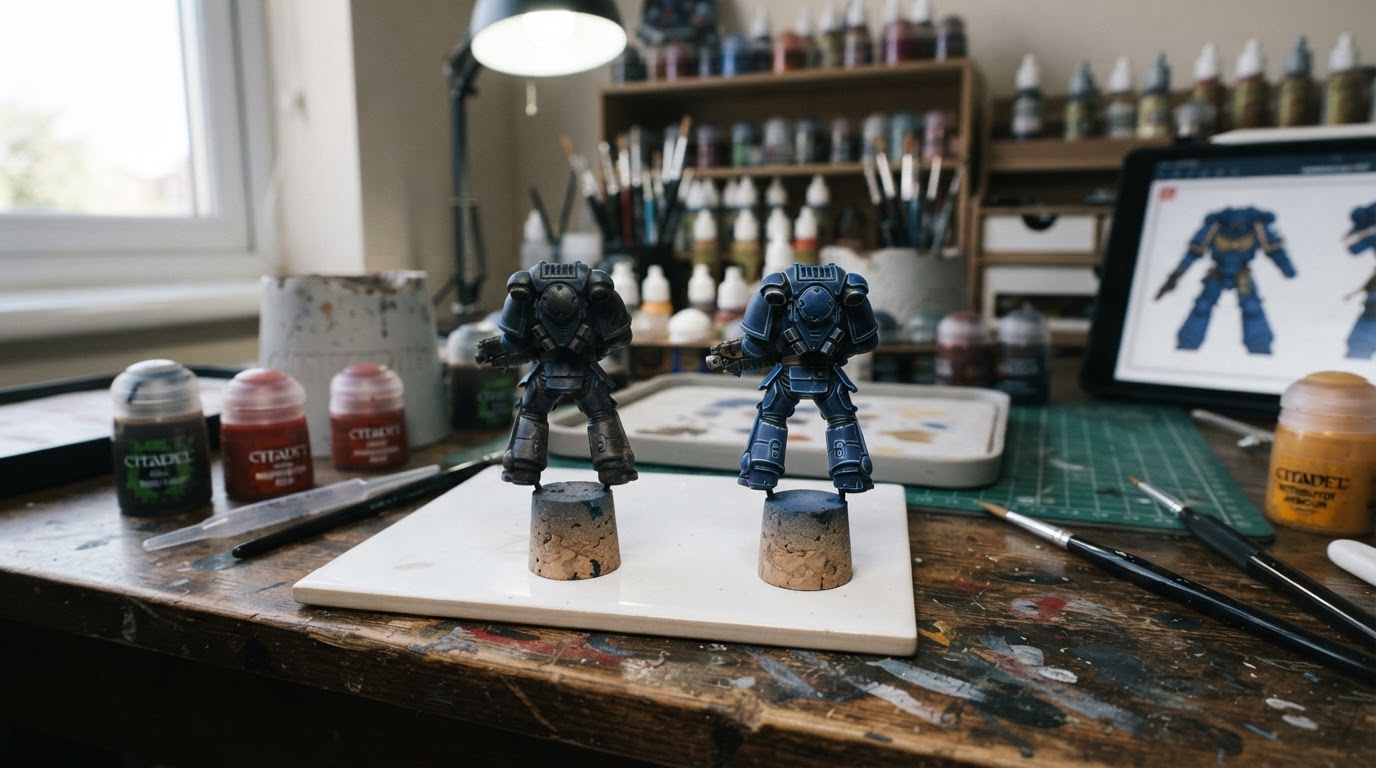
Work from a near-midtone highlight toward a brighter final edge on the most extreme corners only. You do not need pure white on every edge.
Completion check: at arm's length, the silhouette of plates and weapons is easy to parse without leaning in.
5. Optional glaze and color unity
A thin transparent pass (glaze/filter) can unify a surface after harsh highlights. Use it sparingly. The goal is subtle temperature or saturation control, not a new opaque coat.
Completion check: transitions feel connected, and highlights still catch light instead of floating as chalk marks.
6. Texture discipline
The classic studio look usually favors smooth armor and cloth over heavy weathering. Chipping, dust, and battle damage can sit on top later. Learn the clean read first; weathering is optional flavor, not the foundation.
Where to find legitimate guides and PDFs
You can learn 'Eavy Metal methods from currently reachable official articles, creator tutorials and community recipe archives. Treat "PDF" as a format preference, not a promise that a particular book is available as one.
Prefer these source types
Official or currently authorized digital products when Games Workshop or another rights holder lists a guide, app content, or tutorial package for the exact title and edition. Start from the publisher's own listing, which is also where you confirm format and price.
- Creator-published PDF guides sold or freely released by the painter who made them. A painter sharing their own step-by-step is different from redistributing someone else's book.
- Original free tutorials on hobby sites and video channels that teach basecoat → shade → layer → edge highlight with current paints.
Community paint-scheme archives that document box-art color breakdowns and recipes. The 'Eavy Archive is one example: an unofficial, community-run set of HTML pages and recipe notes, not a publisher document. Use it for color breakdowns and technique vocabulary, and check exact paint names against current ranges.
Treat these with caution
- Scanned copies of commercial books uploaded to file hosts or document libraries are often unauthorized redistributions, even when the upload page looks convenient.
- Forum threads asking for "the 1990s PDF" may point to scarce physical history or to illegal files. Use threads for technique discussion and color notes; do not treat every attached file as safe to download or share.
- Unclear "free download" pages that mirror a commercial title. If the rights holder is not offering that file, skip it.
A practical legitimacy test
Ask four questions before you save a guide:
- Who created this document?
- Who is offering it now?
- Is the offerer the author, publisher, or an authorized seller?
- If the answer is "unknown account with the full commercial book," walk away.
When availability is uncertain, say so to yourself and switch to a living tutorial. Uncertainty is not permission.
What to collect instead of a single magic PDF
Build a small legitimate kit:
- one beginner technique series for basecoats and edges
- one glaze or layer-blend explainer
- one paint-range conversion chart (role-based: base / layer / shade / technical)
- optional scheme notes for the specific army or character you are painting
That kit outperforms a single offline scan because you can update paints and correct mistakes as you go.
Find the exact book, then use reachable resources
If you want a specific classic 'Eavy Metal title, start with its exact title and edition. Check the publisher's listing—Games Workshop or the current rights holder—or a retailer's listing for the full book; that is where format, contents, price and availability are stated. A search result, a forum thread or a file-host page does not answer those questions.
For the technique itself, these reachable resources are a practical starting point:
- White Dwarf Bunker Hobby Hangout painting lexicon — a six-page official Games Workshop PDF. It explains technique versus result and defines spray, airbrush, layer, wash, recess wash, drybrush, overbrush, edge, pin, zenithal and glaze work, along with paint roles, mediums, and the Battle Ready versus Parade Ready standards. Page 5 describes Contrast Medium for making Contrast paint more translucent. It is a terminology and technique reference, not a complete beginner assembly book or a classic 'Eavy Metal masterclass. Open the PDF.
- Warhammer Community painting articles — Games Workshop's free HTML articles on its own paint system. The Battle Ready explainer sets out the Classic and Contrast methods and what the standard means. These are articles, not downloads. Read the Battle Ready explainer.
- 'Eavy Archive — a free, unofficial archive of box-art paint recipes maintained by the Infernal Brush Discord Community. It is a set of HTML pages with recipes and a technique glossary, not a PDF, and it states that it is not endorsed by Games Workshop. It is a community reference. Open the archive.
None of these is a substitute for a specific full book. They are reachable ways to learn parts of the same control loop while you decide which title, if any, you want to buy.
How to practice the style (with a clear finish line)
Practice one control at a time on a cheap test model or spare infantry body. Do not start on your centerpiece.
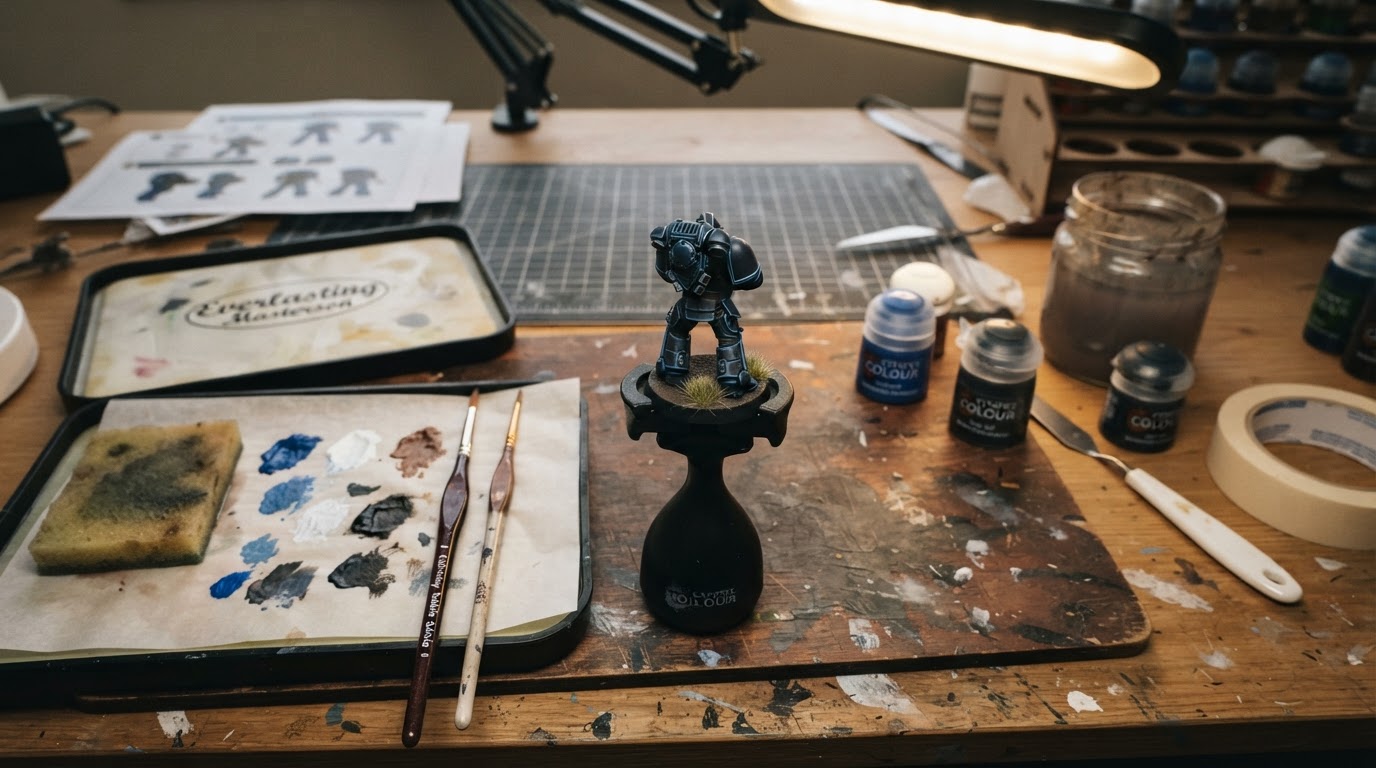
Session plan (about 45–90 minutes)
- Prime and basecoat one material only (for example, armor). Stop when coverage is even.
- Shade recesses only on that material. Stop when depth appears without muddying the midtone.
- Recover midtones on flat plates.
- Place edge highlights on the sharpest edges only.
- Photograph in normal room light from 30–40 cm. If plates separate and edges read, the session succeeded.
Progression ladder
Stage | Focus | Done when |
|---|---|---|
1 | Opaque base + neat recess shade | Panels look solid; recesses are darker |
2 | Midtone recovery | Color identity returns after shading |
3 | Thin edge highlights | Silhouette reads at arm's length |
4 | Second material (cloth or weapon) | Two materials stay distinct |
5 | Small freehand or gem (optional) | Detail does not break the overall read |
Common mistakes and fixes
- Chalky edges: highlight color too light or too thick. Mix closer to the midtone first; thin the paint; use less paint on the brush.
- Muddy armor: shade pooled on flats. Wipe excess; re-layer the midtone; reserve dark value for true recesses.
- Patchy basecoats: paint too thick or too dry. Thin slightly and use more thin passes.
- Everything highlighted equally: reserve the brightest edge for corners and upper rims facing a consistent light idea.
Completion standard for a "studio-like" infantry model
You are done enough when:
- main armor color is identifiable from a short distance
- recesses create shape separation
- edges are thin and intentional
- metals, cloth, and armor do not collapse into one value
no step depended on a file of unknown origin
That standard is reachable with modern acrylics and legitimate teaching materials.
Modern paint substitutes and role mapping
You do not need discontinued pot names to paint in the 'Eavy Metal style. Map historic steps to modern roles.
Studio step | What the paint must do | Modern role examples |
|---|---|---|
Base color | Opaque coverage on primed plastic/resin | Base / foundation / high-coverage layer |
Shade | Darken recesses, increase depth | Wash, contrast-style shade, or mixed recess tone |
Layer / midtone | Restore hue on flats | Layer or thin base reapplied |
Edge highlight | Light value on sharp edges | Light layer, pure highlight, or mixed lighter midtone |
Glaze | Transparent color control | Medium + thin pigment, glaze medium, or heavily thinned layer |
Metal work | Bright ridges, dark recesses in steel/gold | Metallic base + dark wash + edge drybrush or layered bright metal |
Practical substitution rules
- Match opacity and job, not brand loyalty. A base paint is whatever covers cleanly in few coats.
- Separate "shade color" from "mid color." If a single wash stains the whole plate, recover midtones on purpose.
- Mix edge colors. Many classic looks used a progressive ladder (mid → light → brighter extreme), not one jump to white.
- Keep a wet palette or consistent thinning habit. Control beats nostalgia.
- For scheme matching, use box-art recipe notes and current range guides. Community recipe archives can help translate old names into current equivalents, but verify on a test sprue because pigments and finishes differ.
Metals, black, white, and yellow
These colors still decide whether a mini looks "studio" or unfinished:
- Black: leave room for edge definition; pure black with no highlight reads as a hole.
- White: build up; avoid one thick chalk coat.
- Yellow: often needs a warm underpaint or multiple thin passes for opacity.
- Metals: recess shade first, then brighten raised wires and edges so weapons stay readable.
None of these require a particular vintage book. They require patience and a role-based paint plan.
FAQ
Is there an official free eavy metal painting guide pdf?
There may be no free official PDF for the exact classic title you have in mind, and availability differs by book and edition. Identify the title and edition, then check the publisher's listing for the full book. For free technique teaching now, the official White Dwarf lexicon and Warhammer Community articles linked above are reachable, and the 'Eavy Archive is an unofficial recipe reference.
Why do search results show Scribd or file-host "PDF" pages?
Those pages are often mirrors of commercial books rather than publisher listings. A download button does not tell you who authorized the file; use the publisher's listing to confirm the exact title and edition, and use original tutorials for technique.
Can I still paint 'Eavy Metal style without the 1990s books?
Yes. The style is a technique stack—clean base, deep shade, midtone recovery, crisp edges—not a single chapter in a book you may or may not be able to buy.
What about 'Eavy Metal Masterclass or similar titled books?
Named studio and masterclass books are commercial products. Identify the exact title and edition, then check the publisher's or a retailer's current listing for the full book. If it is listed, that is the authoritative source; if you cannot find it, learn the same skills from the reachable official articles, creator tutorials and community recipes linked above.
Are community archives of box-art paint schemes legal to use?
Scheme notes and recipe lists shared as community references are commonly used as painting aids. Use them to mix colors and understand a box-art breakdown; they are a community reference, not a publisher document or a substitute for the full book.
Which paints should beginners buy first?
Buy a small set that covers base colors for your army, one dark shade, a few lighter layer colors for edges, brush cleaner/thinner or medium, and a primer that fits your workflow. Expand only after you can finish one clean infantry model.
How long before the style "clicks"?
Many painters see a readability jump after a handful of deliberate edge-highlight sessions on test models. There is no universal hour count. Use the arm's-length readability check instead of a calendar promise.
Should I weather over the clean studio look?
Only after the clean read works. Weathering on top of muddy values usually hides problems instead of fixing them.
A simple legitimate learning path (checklist)
- Pick one infantry model you can sacrifice to practice.
- Write a four-line plan: base color, shade approach, midtone recovery, edge color.
- Paint one material completely through the stack before starting the next.
- Photograph at arm's-length distance in ordinary light.
- Adjust only one variable next session (thinner edges, deeper recesses, or cleaner bases).
- Add a second tutorial source only if it teaches a missing control (for example glazing), not because you still lack "the PDF."
Bottom line
'Eavy Metal is a readable studio method—clean basecoats, controlled shading, recovered midtones, and crisp edge highlights. To find a specific book, identify its exact title and edition and use the publisher's listing for the full book. To learn the method now, use reachable official technique resources and a clearly labelled community recipe archive, and practice the technique loop on a test model until panels read at arm's length with modern paints mapped by role.